Rank
Rank finds the group's overall order of preference. Participants arrange options from most to least preferred, and Loomio assigns more points to higher-ranked options.
When to use Rank
Use Rank when preference order matters and you want one overall ordering. It works well for:
- selecting one candidate for a position;
- ordering projects for a work plan;
- prioritizing conference topics;
- choosing backup options as well as a first choice; or
- reducing a long list to an ordered shortlist.
Rank uses a points-based ordering. It is not a proportional election method. To elect several people while representing different groups of voters, use an STV Election.
Example: rank bottle designs
Oatmilk Cooperative asks members to rank four bottle designs for its returnable-bottle trial. Participants consider handling, durability, customer needs, storage, and compatibility with the washing equipment.
Set up the poll
State what the ranking will determine and add the options. Set Number of choices to control how many options each person may rank. A first choice receives the most points, the next choice receives one fewer, and unranked options receive no points.
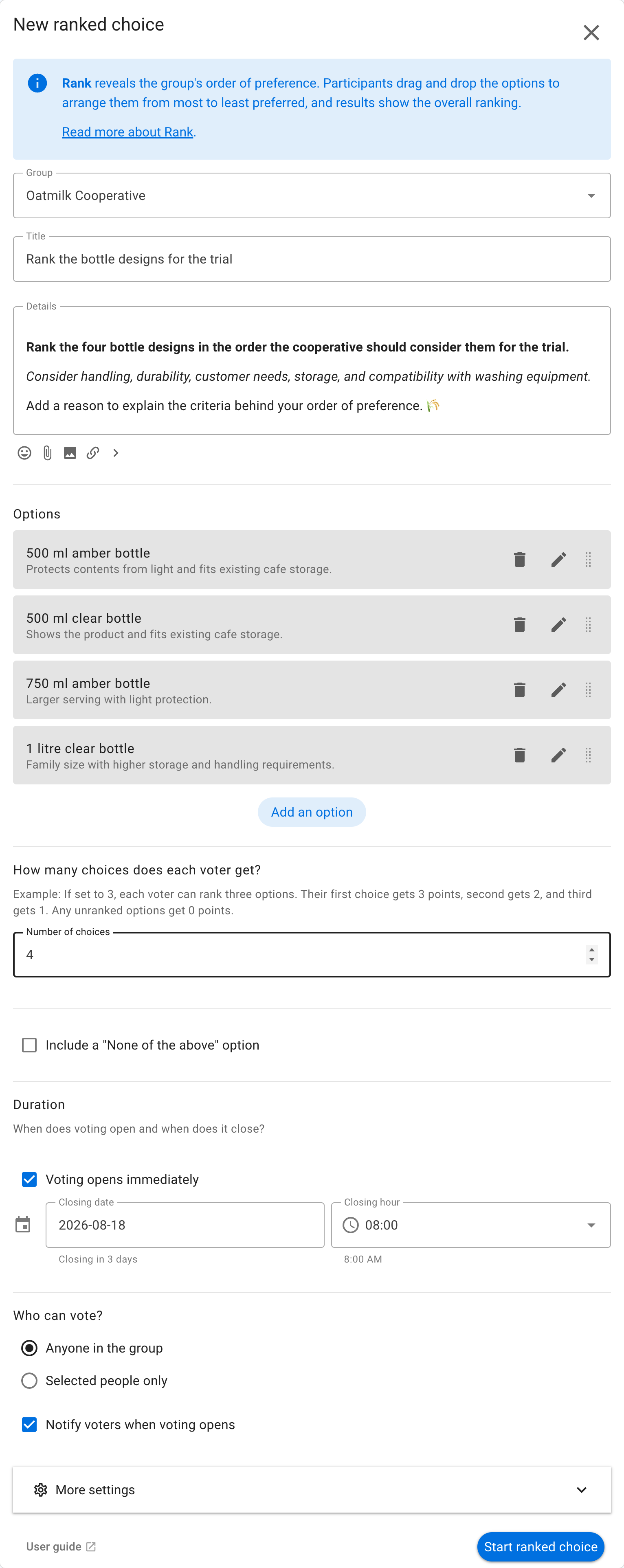
Require all options to be ranked when you need a complete ordering. Allow fewer choices when participants may not know enough to rank everything. Showing options in random order can reduce the influence of their initial presentation.
Vote
Participants drag the options into their preferred order, with number 1 as the first choice. They can add a reason explaining the criteria behind their ranking.
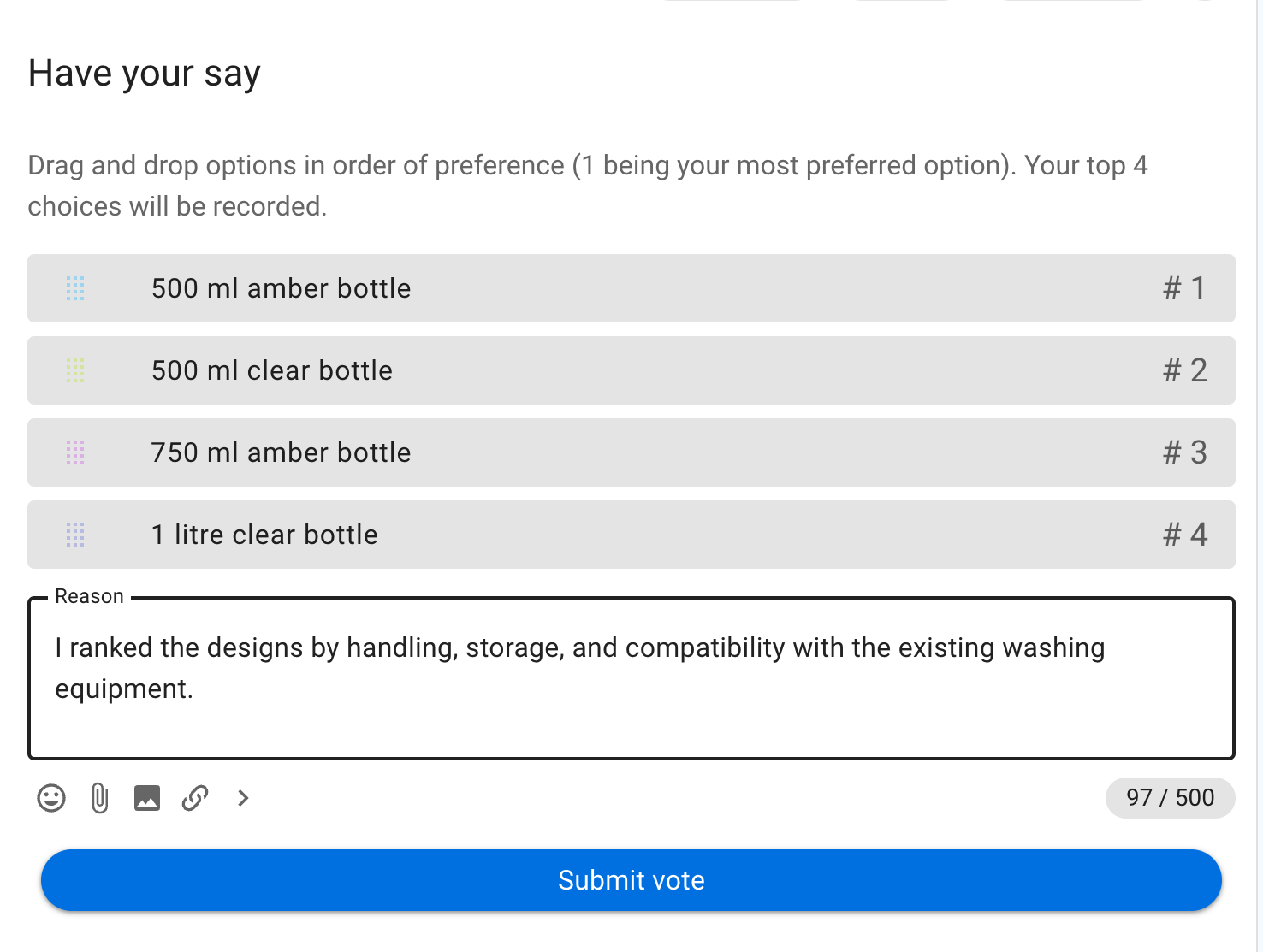
In this example, the voter puts the 500 ml amber bottle first and the 500 ml clear bottle second because both fit the existing cafe storage and washing equipment.
Read the results
The results combine all ballots into an overall points-based ranking. For each option they show:
- Rank: its position in the combined result;
- % of points: its share of all ranking points;
- Points: the total points from all ballots;
- Mean: its average points per voter; and
- Voters: how many people ranked it.
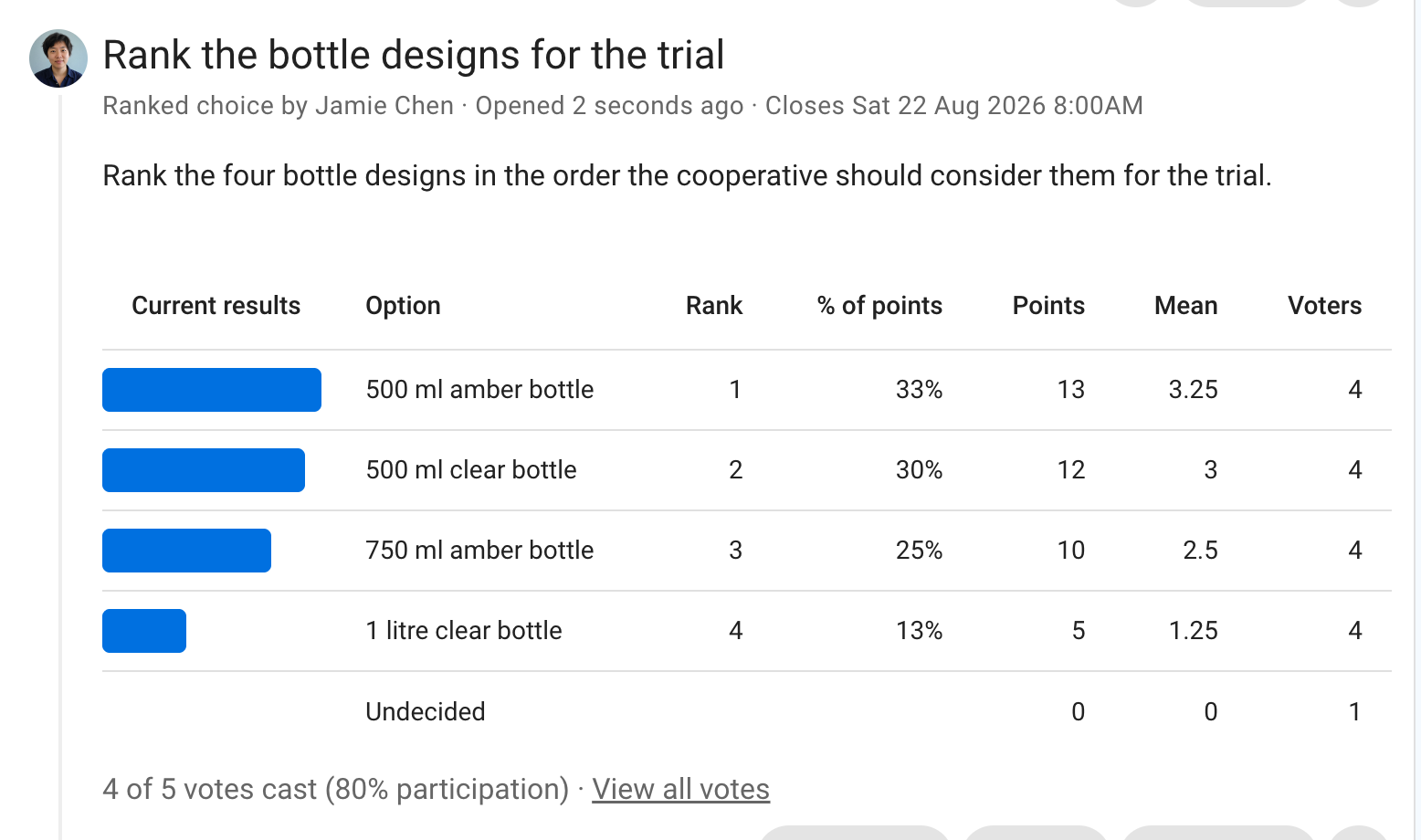
In this example, the 500 ml amber bottle ranks first, followed by the 500 ml clear bottle and the 750 ml amber bottle. The group can investigate the preferred design first while retaining the remaining order as a sequence of alternatives.
A points-based result can conceal different preference patterns that produce the same total. Review individual ballots and vote reasons when options are close or the decision is consequential.