Quorum
What is a quorum, and how
do you reach one?
A quorum is the minimum number of members who must take part for a meeting or a vote to be valid. Your constitution or bylaws set the number. Without it, the group cannot make a binding decision.
Free trial · No credit card required · Nonprofit pricing available
What is a quorum?
In simple terms, a quorum is the smallest number of people who must take part before a meeting or a vote counts. It is a participation rule: it says how many of the people entitled to vote must be present, or must cast a vote. It exists so that a handful of people cannot decide for everyone when most members were not there. A meeting or vote that meets its quorum is called quorate.
The number comes from your governing documents: a constitution, bylaws, articles, statutes or rules. A board might need a majority of its directors. A members’ meeting might need a fixed number or a percentage of the membership. If your documents say nothing, the law your organisation is formed under may set a default.
Quorum is not the same as the vote needed to pass. Quorum asks “did enough people take part?” The approval threshold asks “did enough of them agree?” Most formal decisions need both.
How do you calculate a quorum?
Start from the number of people entitled to vote, not the number who turned up. Apply the fraction in your rules and round up to a whole person. A majority of an 18-member board is 10. A third of 40 members is 14. Then count who took part: if you have at least that many, you have a quorum.
Take a committee of ten with a quorum of half and a rule that a motion passes with a majority of votes cast. If four people vote, there is no valid decision, even if all four agree. If six vote and four agree, the motion passes.
What percentage should a quorum be?
There is no standard figure. Use the one in your rules or in the law that applies to you. Boards and committees commonly need a majority of their members. Members’ meetings often set a lower bar, a fixed number or a smaller share of the membership, because fewer members come. If you are choosing your own, pick a figure your group reaches on an ordinary month, so that decisions are well supported without stalling.
Why groups struggle to reach quorum in a meeting
A meeting asks everyone to be in the same place at the same hour. The more people a decision needs, the harder that gets.
One evening has to suit everyone
Getting half the membership into one room on a Tuesday night is hard. Volunteers have jobs and families, and members in other time zones are asleep. One apology too many and the meeting cannot decide anything.
Missing it costs weeks
When a meeting falls short, the decision moves to the next one, often a month away. Budgets, appointments and rule changes wait, and the people who did turn up have given their evening for nothing.
Nobody knows until the night
You find out whether you have a quorum when you count the room. There is little chance to chase the missing few once the meeting has started.
How voting between meetings changes that
When a vote stays open for several days, people take part when they can. A member who would have sent an apology reads the motion on Tuesday night and votes on Wednesday morning. You can see how many have voted while there is still time to remind the rest.
The ICCA Consortium holds its General Assembly for member organisations in 70 countries, so no session time works for everyone. It opened polls in Loomio before the live sessions and kept them open afterwards.
“We used Loomio’s poll features to allow people to express their views in advance of the General Assembly sessions and also for two weeks afterwards. The votes cast in this way were included in our calculations on whether we had a quorum.”Sarah Ryder, Operations Coordinator, ICCA Consortium
Semkovo Co-op, with 130 owners in 32 countries, wrote online voting into its statutes. Owners discuss and vote in Loomio, and the general assembly confirms the result. “By our statutes, the meeting in person cannot vote on topics that have not been pre-voted online before,” says its chairman, Matthias Zeitler.
Voting outside the meeting should not mean voting without discussion. Some groups find that when ballots are collected ahead of a meeting, people skim the agenda and tick a box, and amendments are harder to handle. Share the motion and its background in a discussion first, leave time for questions, and settle the wording before the vote opens.
Check your own rules first. Whether votes cast outside a meeting count towards quorum depends on your governing documents and the law that applies to your organisation. Some rules allow electronic or postal voting, some need an amendment before you can use it, and some require a meeting. Read the ICCA story and the Semkovo story to see how two organisations set theirs up.
How to set a quorum in Loomio
In Loomio a quorum is a percentage of the eligible voters who must vote. You can set one on a proposal, a poll or an STV election, and everyone can see whether it has been reached.
Step 1
Choose who can vote
Let anyone in the group vote, or pick selected people only, such as the board or a committee. Quorum is measured against the people who are eligible for this vote.
Step 2
Enter the quorum
Open More settings and enter the percentage that must take part. Leave it blank if no quorum applies. Quorum in the help manual
Step 3
Add the approval rule
On a proposal, give an option a requirement such as Agree: at least 75%, counted against votes cast or against all eligible voters. Vote share requirements
Step 4
Watch it fill, then record it
The results list each requirement and mark it with a tick when it is met. When voting closes, write an outcome that says what was decided.
One field sets the quorum.
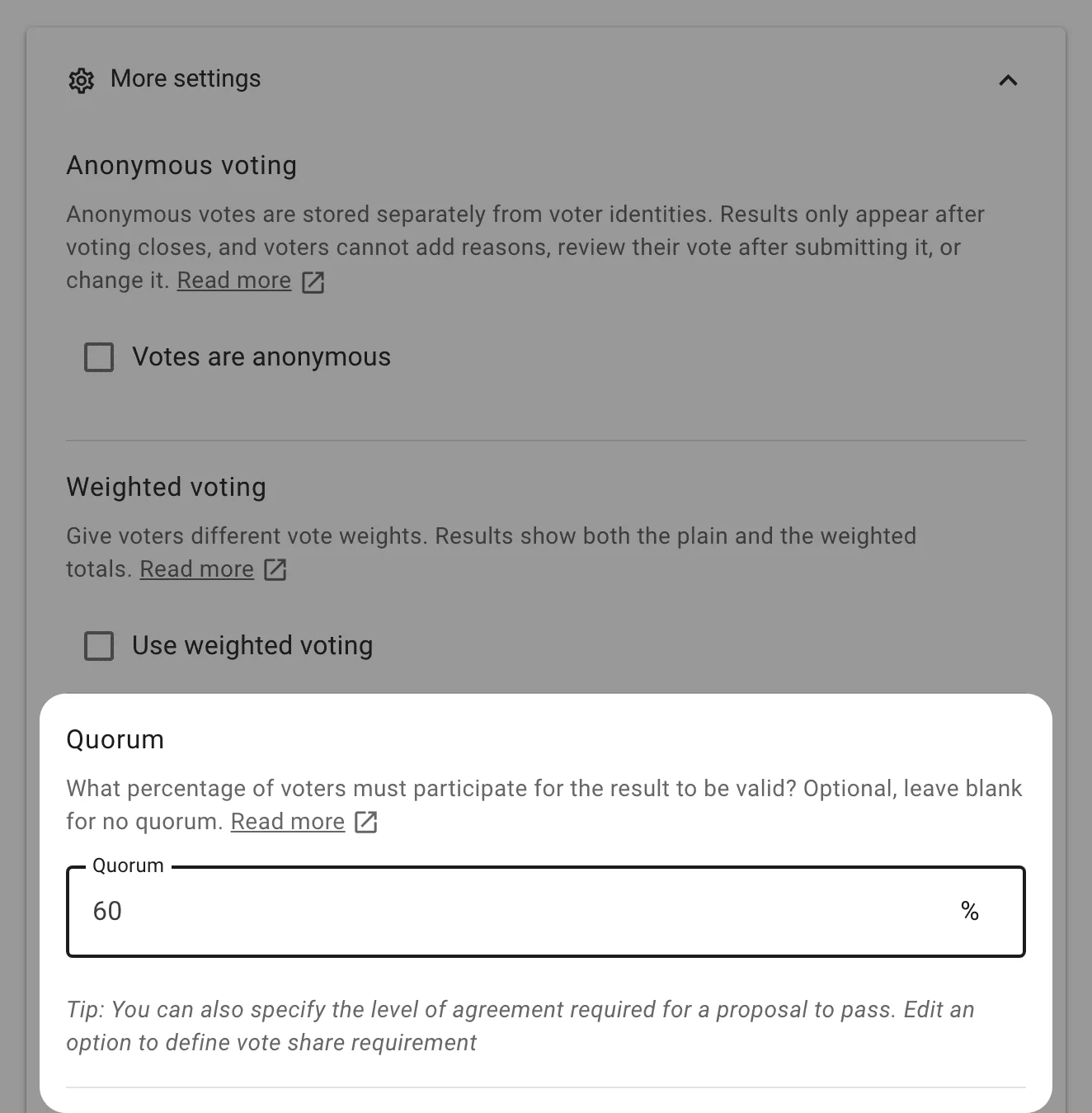
The quorum field asks what percentage of voters must participate for the result to be valid. It sits in More settings, next to anonymous voting and weighted voting.
Loomio treats the figure as “at least”. Enter 60 for five voters and three must vote.
Everyone sees the same count.
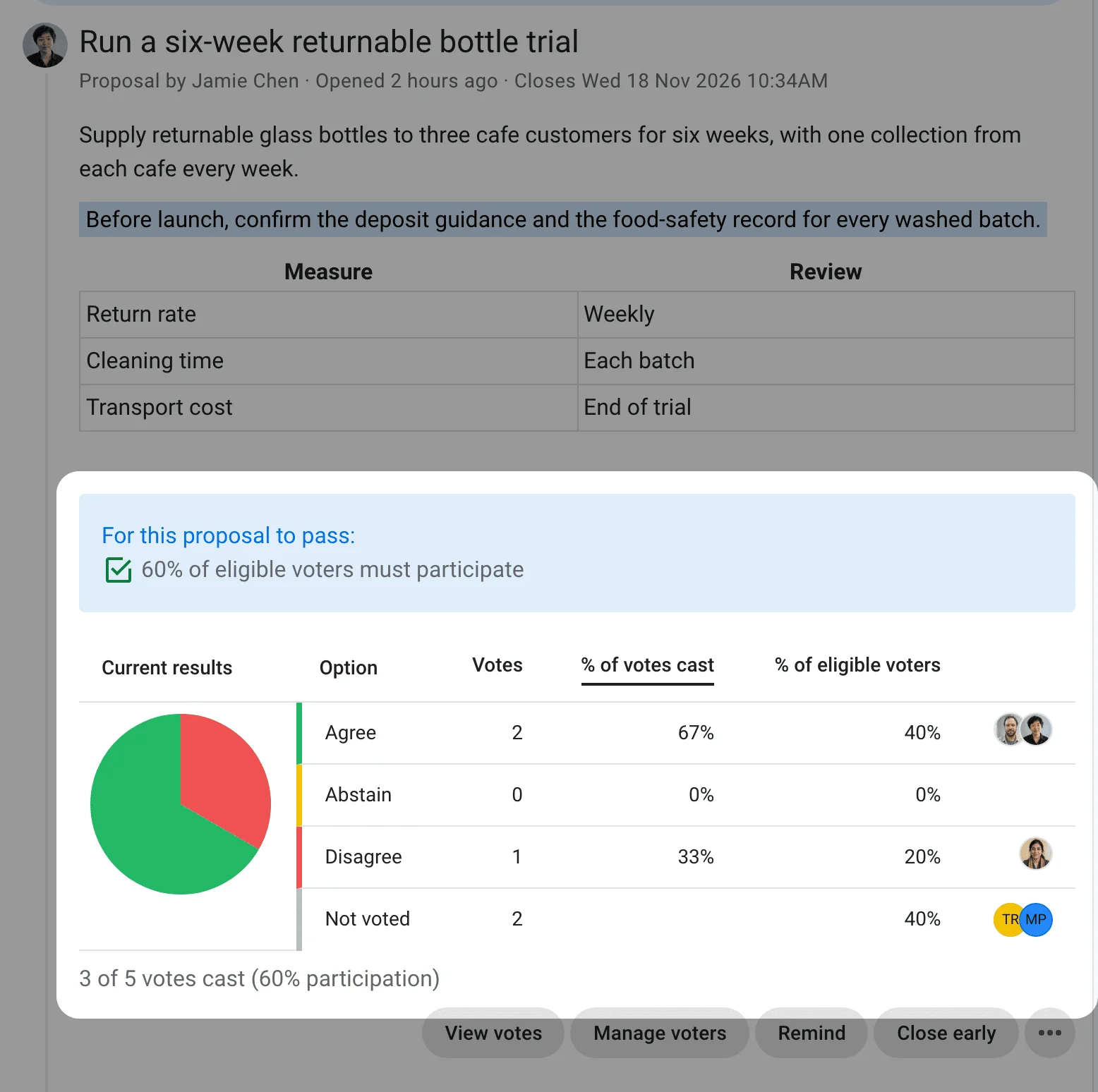
Results show how many of the eligible voters have voted, and each option as a share of votes cast and of eligible voters. With a quorum set, a line above the results reads, for example, “60% of eligible voters must participate”, and is ticked once enough people have voted.
Unless the vote is anonymous, the results also show who has not voted yet. They get a reminder a day before the vote closes, and you can send your own reminder at any time. If you reach quorum early you can close the vote, and if you are short you can extend the closing time.
Loomio shows whether your requirements were met. Declaring the result is still yours to do, in the outcome and in your minutes.
Participation rules three organisations use
A quorum does not have to come from the law. Many groups choose a participation rule so that important decisions have enough people behind them.
30% of staff on serious matters
10Pines, an 80-person software company, asks for at least 30% of staff to weigh in on serious matters such as salary proposals, so that three or four votes cannot settle them.
Half of contributors, and no blocks
At Argot Collective a standard decision passes when 50% of contributors vote yes and nobody blocks. The collective set up templates with these requirements built in.
Online votes, confirmed in assembly
Semkovo Co-op’s decisions are legally binding and go into the trade registry. Owners vote in Loomio, then the general assembly confirms what was decided online.
Common questions about quorum
What happens if there is no quorum?
The vote is not valid, so nothing has been decided either way. Minute that the quorum was not reached. Your rules usually say what happens next: often the matter is adjourned or put again. In Loomio you can extend the closing time while the vote is open, or reopen an identified vote after it closes. Anonymous votes cannot be reopened.
Does an abstention count towards quorum?
That depends on your rules, so check them. In Loomio, everyone who submits a vote counts as taking part, including people who choose Abstain. People who have not voted do not.
Our rules give a number, not a percentage
Convert it. Three of five directors is 60%. Loomio rounds the requirement up to a whole voter, so check the percentage you enter gives the number your rules ask for. If your rules say “more than half”, enter a figure that gives one more than half of your current voters: 60% for ten voters means six.
How do we get more people to vote?
Give people enough days, close before a meeting and not over a weekend, and say plainly what you are asking. Voters are notified by email and can vote from a link in it. Loomio reminds people who have not voted 24 hours before the close. The last few may still need a personal nudge.
What if members hold different numbers of votes?
With weighted voting, quorum is measured in vote weight. If the people who have voted hold 75% of the eligible vote weight, a 60% quorum is met, however few of them there are. Weighted voting is not available for anonymous votes or STV elections.
Do we have to set it up every time?
No. Save the quorum and approval requirements in a poll template, and every vote started from that template uses them by default.
Can members vote by proxy?
Loomio has no proxy setting. Each person votes from their own account, at any time while the vote is open, which removes the usual reason for a proxy: not being able to attend. If your rules count proxies towards quorum, handle those outside Loomio.
How do we show an auditor the quorum was met?
The vote keeps the motion, the eligible voters, the votes cast and the ticked requirement together. Export the results to a spreadsheet, or print the discussion or save it as a PDF. Loomio does not certify a result; your chair or secretary does that.
Is a quorum needed for an election?
If your rules set one, yes. You can set a quorum on an STV election in the same way as on a proposal, and the results show whether it was reached.
Related guides
Board decisions between meetings
What a sound decision outside a meeting needs, from notice to the minutes.
Online voting
Motions and elections for member organisations, and Loomio for boards.
Try it on your next vote
Set up a proposal with your quorum, invite a few committee members, and see how quickly the votes come in when nobody has to be in the room.
Free trial · No credit card required · See pricing