Anonymous voting
Anonymous voting and
secret ballots online
Anonymous voting means the group sees the result of a vote, but nobody can see how any one person voted. Groups use it for elections, sensitive decisions, and any vote where people might hold back if their name were attached.
Free trial · No credit card required · Nonprofit pricing available
What is anonymous voting?
Anonymous voting means a vote cannot be connected to the person who cast it. Everyone who is entitled to vote gets one vote, the votes are counted, and the group sees the totals. Who chose what stays private. In a meeting this is called a secret ballot; online, it is usually called an anonymous vote or an anonymous poll.
The point is to let people vote the way they really think. When names are attached, people hold back. They worry about a manager, a neighbour, a friend who is standing for election, or who outside the group might see the list. And when they can watch the votes come in, they start to vote tactically.
Anonymous does not mean unaccountable. The group still decides who is eligible, each person votes once, and the result is recorded. Only the link between a person and their choice is removed.
When groups use anonymous voting
Most everyday decisions are better made in the open. These are the times a private ballot helps.
Elections
Choosing directors, committee members, officers or representatives, where people are voting on colleagues and friends.
When your rules require it
Some constitutions, bylaws and laws call for a secret ballot on particular motions or elections, or say a vote cannot be changed once it is cast.
Sensitive or contested decisions
Pay, budget priorities, personnel matters, or a proposal the group is divided on. People answer more honestly without their name on it.
Uneven power in the group
When senior and junior people vote together and one person’s position could sway the rest.
NYC-DSA uses anonymous voting for its large member votes, because its members are regular targets of political attacks. mondora, a software company of 60 people, put salary transparency to an anonymous vote.
Running a formal motion or an election? See online voting for motions and elections.
How to run an anonymous vote in Loomio
Loomio is a place for a group to discuss a question and then decide it. Any proposal or poll can be made anonymous.
Start a proposal or poll, and turn on Anonymous voting in its settings before voting opens. Voters see a notice that the vote is anonymous, make their choice, and get a confirmation that their vote was recorded. When voting closes, the results appear as totals.
If your group often votes this way, save a poll template with anonymous voting already switched on, so nobody has to remember the setting.
Read the technical details in the help manual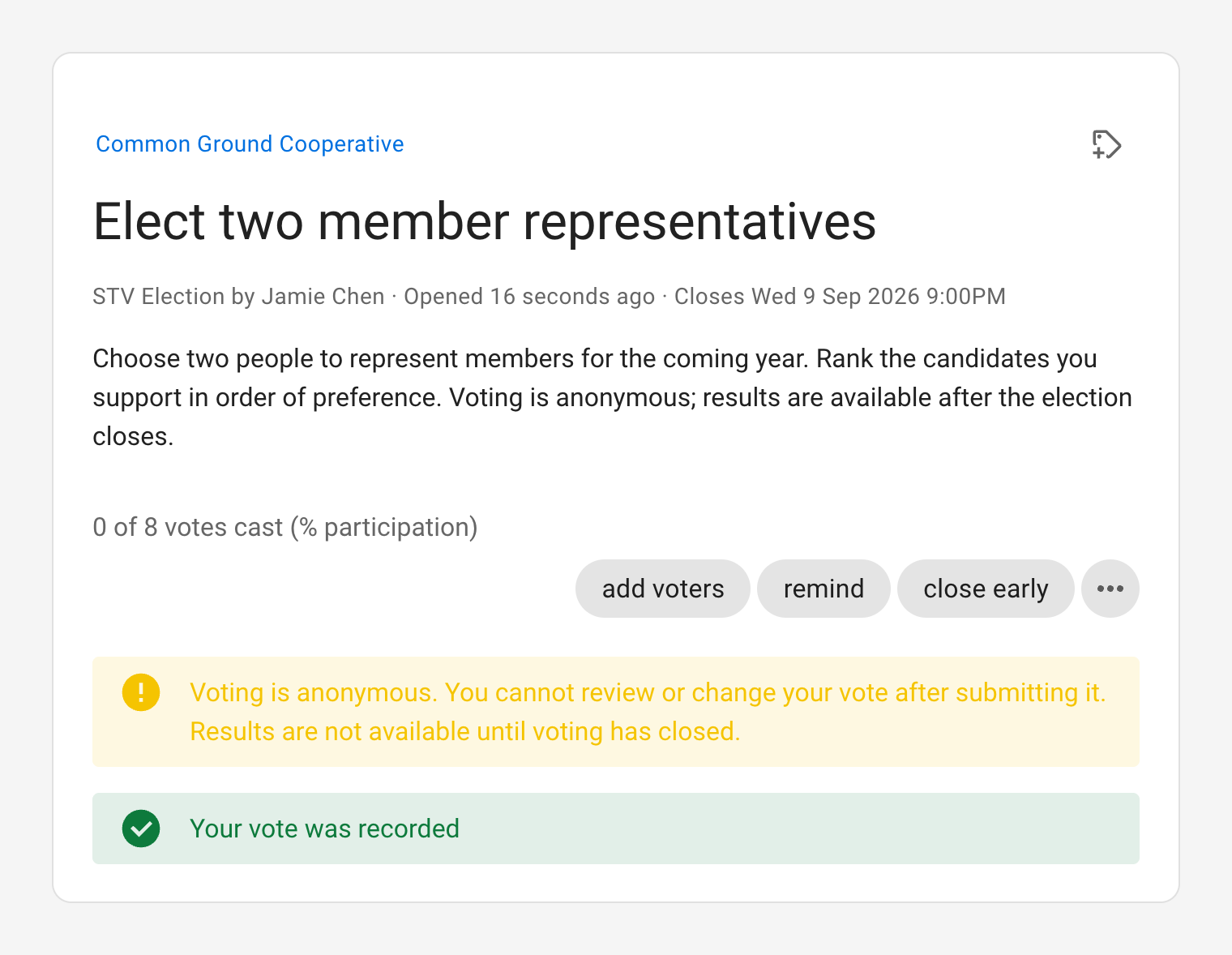
What Loomio does when a vote is anonymous
These protections come together. You cannot switch on one without the others.
Votes are stored without names
Loomio keeps the record of who has voted separately from the votes themselves. A submitted vote carries no name, user account, or precise time.
Results stay hidden until voting closes
Nobody sees a running tally: not members, not the person who started the poll, not group administrators.
One vote each, and it is final
Each eligible person can vote once. A submitted vote cannot be reviewed, changed or withdrawn, by the voter or by an administrator.
No written reasons on the ballot
A reason or an attachment could identify the voter, so anonymous votes do not include them. People can still discuss the question under their own names in the thread.
A reminder before it closes
When voting runs for a day or more, people who have not voted yet get one automatic reminder in the final 24 hours.
It cannot be undone
Once voting has opened, the anonymous setting cannot be turned on or off, and an anonymous poll cannot be reopened after it closes.
Anonymous voting works with proposals, simple polls, score polls, dot voting, ranked choice and STV elections. Weighted voting is not available for anonymous votes.
Semkovo Co-op’s 130 owners make legally binding decisions online. Some of them asked whether results could be manipulated or over-influenced by the leadership.
“As an admin, there are some things I can’t see. If it’s secret, then it’s secret. This gives reassurance to people: we have a tool that has certain ways of doing things, and it’s documented. And I can’t change other people’s votes.”Matthias Zeitler, Semkovo Co-op
Anonymous voting and blind voting: what is the difference?
The two terms are often used for the same thing, but they describe different protections.
Anonymous voting hides who cast each vote. Blind voting hides how the vote is going: nobody sees the results until voting closes, so early votes cannot sway later ones.
In Loomio, an anonymous vote is always both. Votes are separated from voters, and results stay hidden until the poll closes. That is why Loomio’s help manual treats “blind voting” as another name for anonymous voting.
If you want people to vote without seeing how others have voted, but still want names attached to votes afterwards, leave anonymous voting off and use the Hide results setting. It can hide results until each person has voted, or until voting closes.
When open voting is the better choice
Anonymity has a cost: you lose the reasons. In an open vote people say where they stand and why, and the group can respond. Choose for each decision.
Use anonymous voting when
- You are electing people.
- Your rules call for a secret ballot.
- The topic is sensitive, or people may feel pressure to vote a certain way.
- The discussion has already happened and the group is ready to decide.
Use open voting when
- You want to hear each person’s reason, and follow up on concerns.
- The group is still working towards agreement, and people may change their position.
- People are accountable for how they vote, as board members often are.
- The group is very small, so a result could show how individuals voted anyway.
- Your rules give members different vote weights.
A common pattern is to do both: discuss the question openly in a thread, under your own names, then hold the vote anonymously.
Common questions about anonymous voting
Can administrators see how someone voted?
No. Nobody using Loomio can connect a submitted vote with the person who cast it, and that includes group administrators and the person who started the poll. Voters see a notice on the ballot saying the vote is anonymous, and the protections are written up in the help manual for members who want to check.
Can we see who has voted and who has not?
Not while voting is open. Loomio reminds the people who have not voted without showing anyone who they are. After the poll closes, people who can see the results can see who was eligible and, once enough people have voted, who took part. They never see how anyone voted, or when.
Can I change my vote?
No. Changing a vote would need a link between you and your vote, and anonymous voting does not keep one. Check your choice before you submit.
We started a poll without making it anonymous. Can we switch it on?
No. The setting is fixed once voting opens, in both directions, so nobody can remove anonymity part-way through either. Start a new poll with anonymous voting turned on. A saved template prevents the mistake next time.
Can the discussion be anonymous too?
No. Anonymous voting covers the votes. Comments in the discussion appear under each person’s name, which is why anonymous ballots carry no written reasons.
Is an anonymous poll the same as a secret ballot?
It serves the same purpose: each eligible person votes once and their choice stays private. If your bylaws require a secret ballot, check the protections and their limits against your rules.
Can a result give away how people voted?
Sometimes. If every vote is the same, everyone who voted is known to have voted that way. In a very small group, a result can make individual choices easy to guess. Think about the size of the group before relying on anonymity.
Is it suitable for every election?
No. Loomio stops the people using it from linking a vote to a voter. It is not cryptographic protection against whoever operates the server. Elections that need independently verifiable, cryptographic secrecy need a system built for that.
Can we run an election anonymously?
Yes. Loomio’s STV elections can use anonymous ballots, and a closed election can be exported for an independent recount without voter identities. See online voting for motions and elections.
Can we try an anonymous poll for free?
Yes. The free trial runs for 14 days with up to 10 people, which is enough to run an anonymous poll with your committee and see what voters see.
Run your first anonymous vote
Start a trial, invite a few people, and put one real question to an anonymous poll. You will see what voters see, and what stays hidden.
Free trial · No credit card required · See pricing