Board resolutions
How boards make decisions
between meetings
Many boards can decide without meeting, usually through a written or circular resolution. Whether yours can, and how many directors must agree, depends on your governing documents and the law where you are registered. Check those first, then run the vote somewhere that keeps a record.
Free trial · No credit card required · Nonprofit pricing available
Can a board vote by email or online?
Often yes, but the rules differ from one organisation to the next. A decision made outside a meeting goes by several names: a written resolution, a circular or circulating resolution, a resolution in writing, unanimous written consent, or an out-of-session decision. They all mean the directors agreed to a motion without sitting down together.
Two things decide whether it is valid for your board: the law your organisation is formed under, and your own constitution, bylaws or articles. They commonly differ on:
- How many must agree. A common rule is that every director entitled to vote must agree in writing. Other rules accept a majority or a set proportion.
- What form the agreement takes. Some rules ask for a signed document. Others accept email or another electronic record.
- Which decisions are allowed. Some matters may be reserved for a meeting.
Older governing documents often mention only meetings in person and votes by post. If yours do not allow a binding decision outside a meeting, you have two routes. Many boards discuss and vote online, then ratify the result at the next meeting and record it in the minutes. Others amend their rules: Argot Collective wrote into its articles of association that decisions made in Loomio are binding. Read the Argot story.
This page is general information, not legal advice. Read your governing documents, and ask your lawyer, company secretary or regulator if they are unclear.
Why decisions between meetings go wrong
A month is a long time between meetings when something cannot wait. The usual workaround is email, and email was not made for voting.
The decision waits
A contract, a grant deadline or an appointment sits for weeks until the board is next together. Then it competes for time with routine items such as approving the minutes.
The email vote is a tangle
Replies arrive on different threads. Someone answers an earlier version. Two directors say nothing, and nobody is sure whether the motion has passed. Or a few people settle it between themselves and the rest hear about it at the next meeting.
There is no record to minute
The result lives in the chair’s inbox: a personal archive, not the board’s record. When an auditor, a new director or a member asks what was decided and who agreed, someone has to piece it together.
What a sound between-meetings decision needs
Whatever your rules say about the details, these six things help an out-of-meeting decision hold up later.
1. Notice to everyone entitled to vote
Every director gets the motion and the papers at the same time, with enough days to read them and ask questions. Nobody is left out because they missed a thread.
2. A clear motion
One question, written out in full, that can be answered for or against: what is approved, how much it costs, who will act and by when. If the wording changes, start a new vote.
3. The right voters
Only the people entitled to vote are counted. Staff and advisers can inform the discussion without voting. A director with a conflict of interest follows your rules on declaring it and standing aside.
4. Quorum and the approval threshold
Know how many directors must take part and how many must agree before you start. For a written resolution that may be all of them. What is a quorum?
5. A closing date
Say when voting ends. A motion with no deadline never fails; it drifts. A date also tells directors how long they have to raise a concern.
6. A record for the minutes
Keep the motion, the papers, who voted and how, and the outcome in one place. Note the decision in the minutes of the next meeting, and ratify it there if your rules ask for that.
Fees agreed in three days, not three meetings.
Seven volunteers run Pōneke Watersports, a dragon boat club with 106 paddlers. Setting the season’s fees used to take the committee two or three monthly meetings. This season they put the options into one poll in Loomio.
“Within three days we had a unanimous vote and we could set the fees straight away. So we didn’t waste three hours discussing it.”
Jo Bowley
Club President, Pōneke Watersports
How boards do it in Loomio
Loomio keeps the papers, the discussion, the vote and the outcome together in one discussion, in a private space for your board.
Step 1
Share the papers
Start a discussion in the board’s group, attach or link the documents, and notify the directors. Notification history shows who was notified.
Step 2
Take questions
Directors ask questions and raise concerns in the discussion, where everyone on the board reads the same answers. Amend the motion before you put it.
Step 3
Put the motion
Start a proposal with the motion, a closing date, and the voters: the whole group or selected people only. Set the quorum and the share of agreement your rules require.
Step 4
Record the outcome
When voting closes, write an outcome that states what was decided and what happens next, and notify the board. It stays with the vote.
Read the help guide to resolutions and out-of-session decisions
The record writes itself as you go.
Directors are notified by email and can vote from a link in it. They can give a reason with their vote, and change their vote while the proposal is open. People who have not voted are reminded a day before it closes.
Results show who voted for each option, how many of the eligible voters took part, and whether the quorum and approval requirements were met.
For the minute book, export the results to a spreadsheet, or print the discussion or save it as a PDF.
Loomio for boards and committees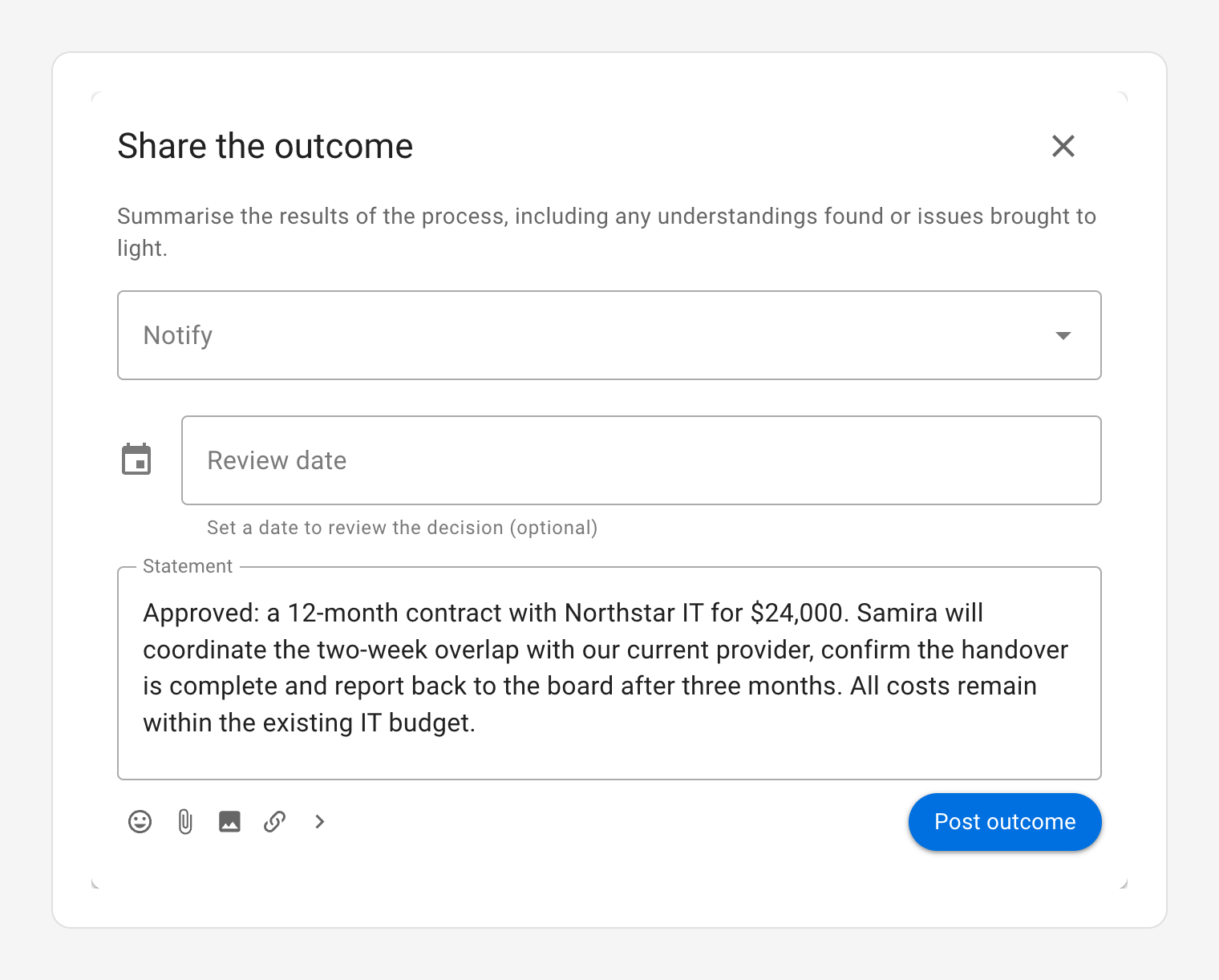
Boards and committees that decide this way
A record across three continents
World Resources Institute’s distributed team discusses consequential decisions in Loomio, keeping the record separate from everyday messages.
Votes that go into the trade registry
Semkovo Co-op wrote online voting into its statutes. Its 130 owners vote in Loomio and the general assembly confirms the result. “For us, this really is a legally binding vote,” says chairman Matthias Zeitler.
Meetings that finish on time
With everyday decisions made between meetings, Pōneke Watersports’ committee uses its monthly meeting for the club’s goals. Meetings that ran two hours without decisions now finish on time, if not early.
“The record is really the key thing. Separating these consequential decisions from the noise. From email, from chat. Having a place where you can easily reference what was decided and why.”Jared Messinger, World Resources Institute
Common questions about board votes between meetings
Is a vote in Loomio legally valid?
Your rules decide that, not the software. If your governing documents and the law allow the board to decide this way, Loomio gives you the notice, the vote and the record. If they do not, you have two routes. Decide in Loomio first, then confirm the same motion at a meeting, as Semkovo Co-op does by design: owners vote on everything online and the official general assembly simply confirms those votes. Or change your rules so the online decision is official, as Argot Collective did in its Articles of Association.
Our rules need every director to agree
Set the Agree option to need at least 100% of eligible voters. The results then show the requirement as met only when every director has voted in favour. Vote share requirements
Our rules need a signed resolution
Loomio records each director’s vote under their own account. It does not collect signatures, so nobody is asked to upload one. If your rules ask for a signed document, reach the decision in Loomio and sign the resolution the way your rules require.
Some of our directors are not keen on new software
They can stay in their inbox. Each director gets the motion by email and votes from a link in it. Tell them that when you introduce it. Start with the board alone and one easy motion, so the first vote is a simple one.
What if directors still do not respond?
Loomio sends a reminder a day before the vote closes, and the results show who has not voted, so the chair knows whom to call. A reminder does not replace that call for the last one or two. A clear closing date and a short motion help most.
What happens to the record if we leave?
It is yours. Group admins can export the group’s discussions and decisions at any time, and you can print any discussion or save it as a PDF for the minute book as you go. Data export and hosting
Can staff follow the discussion without voting?
Yes. Who can read a discussion and who can vote are separate. Restrict the proposal to selected voters, or invite a guest by email into one discussion without giving them access to the rest of the group.
Can the vote be a secret ballot?
Yes, with anonymous voting, though most board resolutions need to show who agreed. An anonymous vote records who took part, not how each person voted. How blind voting works
How do we bring it into the minutes?
Add an item to the next agenda to note the decisions made since the last meeting, and record them in the minutes. You can also post draft minutes in Loomio and ask the board to approve them before the next meeting, which saves the time in the meeting itself. Help guide to board meetings
Related guides
Loomio for boards
Deliberate, vote and keep the governance record in one place.
Online voting
Motions and elections for member organisations, including STV board elections.
Start with the decision that cannot wait
Pick one motion that would otherwise sit until the next meeting. Approving the last minutes is a good first one. Invite your board and see how it goes.
Free trial · No credit card required · See pricing