How Loomio works
Every decision follows a clear path: discuss with context, decide with reasoning, and keep a permanent record.
Start a focused discussion
Important decisions need more than a chat message. Start a Loomio thread with background context, supporting documents, and a clear framing of what needs to be decided.
Tag the right people. Keep the conversation in one place — not scattered across email chains, chat rooms, and meeting notes. Everyone can contribute on their own time, from any time zone.

- Threaded comments and replies with @mentions
- Rich text editor with file attachments
- Pin important comments to the timeline
- Tags and categories for organization
- Reply by email — participate from your inbox
- Automatic translation for multilingual groups
"If these weighty discussions would happen on Loomio, it'd be much easier for me to follow — I often wake up to hundreds of chat messages and just scroll back and try to make some sense of this unthreaded conversation."
— Sean, Argot Collective
Make a decision — with reasoning, not just a count
Most tools treat decisions as a transaction — put up a vote, count the result, move on. Loomio goes further.
People share their reasoning when they vote, so you don't just see what people think — you understand why. When someone disagrees, you can read their thinking. Perspectives shift, understanding deepens, and better outcomes emerge.
Every decision has a deadline. Reminders go to people who haven't voted yet. When it closes, you record the outcome and next steps.

- Vote with reasoning — share why, not just what
- Change your vote as new information arises
- See who voted and read their reasoning
- Discuss and refine proposals through multiple rounds
- Record the outcome and what happens next
- Targeted reminders for undecided voters
"Before we vote, people are normally very vocal, but after we have voted, everyone is like, okay, now we have made a decision, and that's a decision."
— Matthias Zeitler, Semkovo Co-op
Every group decides differently
Consensus, consent, majority vote, advice process — whatever your governance model, Loomio supports it. We include templates for common approaches, but these are just editable starting points. Customize them as your processes evolve.
Consensus
Reach collective agreement with everyone involved. Discuss, amend, and seek broad support.
Majority
Simple majority voting for straightforward choices where a clear vote is all you need.
Create your own templates based on your governance practices, so your processes are encoded, repeatable, and easy for new members to follow.
"Self-management promises better, faster decision making — we proved this benefit by achieving company wide consent to the biggest, most strategic decision the company has ever made, within a week, on Loomio."
— Edwin Jansen, Raise (Ian Martin Group)
Polls and voting
Not every decision needs a proposal. Loomio has a suite of voting methods for gathering preferences, prioritizing strategy, scheduling meetings, running elections, and checking group sentiment.
Proposals
Agree, abstain, disagree, or block — vote with reasoning on any proposal
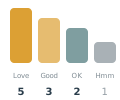
Sense checks
Test group sentiment informally before a formal decision
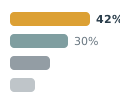
Multiple choice
Single or multiple choice to find the most popular option
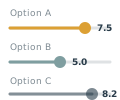
Score polls
Measure level of support on a sliding scale
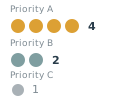
Dot voting
Reveal priorities by distributing a limited budget of points

Ranked choice
Find the group's order of preference

Time polls
Find the best meeting time across time zones, then send calendar invites

STV elections
Proportional representation voting for board elections
Advanced voting features
Need a blind vote? Loomio supports anonymous voting and hidden results, so participants vote based on their own judgement — free from social pressure. Perfect for sensitive decisions, board elections, and honest feedback.
- Anonymous and blind voting
- Quorum requirements
- Scheduled poll opening
- Hidden results until voting closes
- Required vote reasons
- CSV export for analysis
"If it's secret, then it's secret. This gives reassurance to the people. I can't change votes of other people. We have a tool that has certain ways of doing things, and it's documented."
— Matthias Zeitler, Semkovo Co-op
A searchable archive that grows more valuable over time
Every discussion, every vote, every reason, every outcome — searchable and accessible for years. New members can read the history and understand not just what was decided, but why.
Your group's culture, institutional knowledge, and decision-making history is preserved. No more "why did we decide that?" — the answer is always there.
- Searchable archive of every discussion and decision
- Recorded outcomes with next steps
- Complete audit trail with timestamps
- Participation reports — see engagement over time
- Export data as CSV, HTML, or JSON
- Review dates for revisiting past decisions
"Loomio is very important for us, not just from the perspective of input we want to gather, but from the archival perspective. People can point to the exact discussion when a decision was made, and why."
— Anton Arapov, OpenSSL Project
Integrate with the tools you already use
Loomio is the place for the discussions and decisions you'll want to look back on. It replaces group email chains, not your other tools.
Send notifications and outcomes to your team's chat channels. People can reply by email without ever visiting the platform — critical for teams where not everyone lives in the same tools.
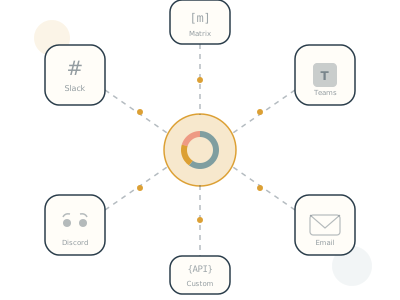
- Slack, Microsoft Teams, and Discord
- Matrix and Mattermost
- API for custom integrations
- Reply by email from any email client
- Group email addresses for starting threads
- Catch-up emails so nobody falls behind
Organize your groups, control who decides
Mirror your organization's real structure with nested groups and subgroups. A board subgroup for directors, a working group for the project team, a members group for everyone.
Each group has its own privacy settings, permissions, and member roles — giving you fine-grained control over who sees what and who can vote.

- Nested subgroups for teams, projects, and boards
- Open, closed, or secret privacy settings
- Granular member permissions
- Delegated voters for representative governance
- Member roles and titles
- Guest invitations for external participants
"It was just enough to bring this question up to the place where people can participate. And they figured out that the community's opinion is sometimes absolutely opposite to what the engineers assumed."
— Anton Arapov, OpenSSL Project
Legally binding decisions — if that's what you need
Reference Loomio in your constitution, bylaws, or founding documents to make decisions formally binding. Used by boards, cooperatives, and membership organizations for formal governance.
With clear audit trails, recorded outcomes, quorum requirements, delegated voters, and timestamped votes, Loomio provides the governance infrastructure for legitimate, defensible decisions. Anonymous and blind voting ensures secret ballots when your constitution requires them.
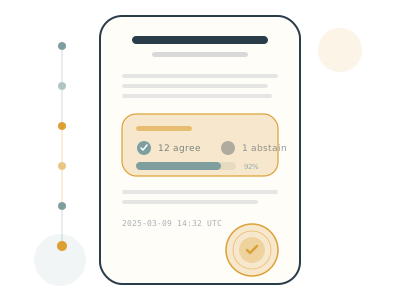
- Complete audit trail of every decision
- Recorded outcomes with next steps
- Configurable quorum thresholds
- Delegated voters for representative governance
- Timestamped votes and export for compliance
- Anonymous and blind voting for secret ballots
"One of our first decisions at the General Assembly was to make Loomio decisions count as official ones. It's in our Articles of Association that we can use this sort of governance."
— Anja Petkovic Komel, Argot Collective
Open source software, built by a cooperative
Loomio is made by a worker-owned cooperative based in Aotearoa, New Zealand. We've been supporting decision-making in collaborative organizations for more than 15 years.
Choose cloud hosting in the USA or EU. We also offer managed private servers for customers that need SSO, custom branding, or feature customization.
- Open source code on GitHub
- Cloud hosting in EU, US, or Australia/NZ
- Self-hosting available
- Available in multiple languages with automatic translation
- Export data as CSV, HTML, or JSON
- SSO support for private host and self-hosted
"Loomio was sort of the only fit, the only option, because it was created by people who were living in the collective mindset that we were hoping to embody."
— Sean, Argot Collective
Take the next step
Start a free trial, talk to our team, or explore the complete user guide.
