A Public Resource Management System
How can we benefit the cooperative, peer-to-peer, open source design community, and social enterprise and more broadly apply it to our living environments? How can the web can better engage people with the material world, while also enriching the social, strengthening personal bonds.
This briefer proposes the development of a public resource management widget for Loomio.
This can start by:
Building a knowledge and design database and library of ‘things’, ‘services’, ‘transport networks’, and the ‘places’ they inhabit that link to top facilitators that theorize, build, and maintain them.
As leading facilitators are identified, the hunt for the dream development team can begin—a team that may include some of these fields:
Operations Managers | UX Designers / Data Visualizers / Sensory Artists | Engineers: Software / Automation & Robotics | Product Designers | Materials Scientists | Hospitality | Architects | City Planners | Agriculturists & Landscape Artists
Those disciplines and more would address the following areas:
Agriculture and Fishing | Manufacturing | Repair and Installation of Machinery and Equipment | Electricity, Gas, and Water | Construction | Wholesale and Retail Trade | Transport Storage and Communication | Accommodation and Food Services | Information and Communications | Financial and Legal Activities | Professional, Scientific, and Technical Activities | Rental and Leasing Activities | Administrative and Support Services | Public Administration and Defense | Human Health and Social Work Activities | Community / Voluntary Services
The daunting complexity of the task can be narrowed by starting with a single location and a small set of processes. Company partners can distribute the workload while working in tandem. The framing can start with a single shop, factory, or transport route—and once templates are formed—expand to include city blocks, districts, and whole cities. From the beginning of development, the design principles must enable models flexible enough as not to require continuous work from scratch, by identifying core elements that can transfer to a variety of designs.
Loomio was based on saving time by making decisions more efficiently. This proposal shares the principle of time efficiency with the insanely ambitious goal of a publicly owned resource management application. It will require extensive modeling, roadmapping, and coordination of practically every known discipline on an unprecedented scale. It is here Loomio can leverage the talent of corporations and governments, with the aim of streamlining and integrating the processes of production, service, and decision making better aligned with user feedback, particularly with products and services in mind.
With this a public project, all processes should be made as transparent as possible, so long as it does not endanger any individuals. Mirror worlds generated by participants contributing 3D imagery, sound, and location data, in addition to other ways of data visualization and sensory output, will better enable the cooperation of both users and experts to accelerate innovation, not only for the Loomio platform, but in every field the platform facilitates. Placed in map view, logistics channels can be color coded with icons to provide clarity in depicting the type of good or service when observing streams.
Building this now is important. Facing the pandemic, with the need for lockdown measures, a publicly observable management system can greatly reduce the need for workers, reducing the spread of contagion, and enable the monitoring of processes, including the use of telerobotics to perform tasks, in a variety of locations from the safety of one’s home. Were this system already in place, thousands of lives would have been saved, as a single platform that coordinates a variety of efforts with ability to observe and anticipate demands, items such as ventilators and personal protective equipment, including the ability to direct the person in need to go to locations that can meet medical requirements, could have been utilized. A public resource management system would prevent corrupt governments and opaquely ineffective companies from holding the people that depend on their services to ransom and instead hold them to account. Just as materials, processes, and places become public knowledge, so too, those executing orders and fulfilling tasks. Having such a tool would not only save lives, but enrich life.
Once the proper connections from this proposal are made, with a list of lead developers and projects onboard, a document can be written up and collectively signed to make a proposal to a city, like Amsterdam, that is keen on implementing these ideas. Amsterdam seems like a good partnership considering they have recently expressed an effort to pursue Kate Raworth's Doughnut Economics framework. (https://bit.ly/34MlwQ0) Madrid and Barcelona may also be interested, given it has a healthy social centre culture. This would obviously include the use of Loomio to facilitate municipal decision making, and more ambitiously, may work to democratize the European Union itself, rapidly spanning the globe as an international framework. (See: DiEM25)
One pilot project can involve the partnership with or something like MIT's OpenAg initiative, able to provide food sustainably for the city, while reducing transport miles from imports. The various aspects of manufacturing, warehousing and feedstocks, transport, and construction can follow, outfitting the city with sensors that provide dashboards for non-experts to assess the health of the city, including the ability to participate in planning, product design, and all the other functions required to operate and manage a city.
OpenAg can be one of many partners that supply the open source restaurant, a concept demostrated by the Waag community in 2009. (waag.org/en/project/instructables-restaurant) Local farm and supply partners will be aware of each open restaurant, while the resturant will be aware of all participating projects that might serve it.
In simple terms, this proposal is advocating to become something like Docker in that it provides a framework for any variety of projects to launch quickly and work and communicate with everyone else in the ecosystem, while also retaining a vision, roadmap, and collective mentorship that encourages the thriving population of that ecosystem, including mobilization to attract interest from and to convert legacy systems. Widgets or design elements must be assembled into an intuitively navigable library similar to that of Git, also coupled with a prediction engine that automatically draws up a list of widgets for each problem area as it is pursued within the design process.
Hack on! Such systems can develop using a planned staging of hackathons. The following tools assembled by the hackathon team at EUvsVirus are a go-to for making viable products from hackathons:
Miro: team collaboration, charts and planning
Airtable: collect data via a form view and manipulate it via table view
Bubble: build full apps without coding (database, view, logic)
Glide: build mobile web apps in minutes
Firebase: powerful and easy to setup backend with api and websocket support
Backendless: powerful and easy to setup backend with api and websocket support
InVision: easy to use design tool with click-dummy features
Workstreams: results-oriented, data-driven task management solution & kanban board app integrated to Slack
A number of hackathons can be planned to take on each sector and each area within a sector. It can start with the most vital areas such as energy, agriculture, manufacturing, logistics, services, and the most labor intensive aspect of the economy: maintenance.
Business plan. Once people and projects are onboard, having remotely and collectively developed a white paper and roadmap, we can then work to drum up funding. The funding would go to 'core support': cloud services, a core programming and design team, marketing/promoting/outreach and customer support. The program would be open source and free to use, enabling rapid adoption and networking of users within the ecosystem. Donation campaigns can be tried, as they seem to work for the Wikimedia and Mozilla foundations, but if needed, a monthly fee can be introduced to high volume users, with free use for low volume, small business/governments until, in time, the protocols are tweaked and usable without need for core support nor funding.
Thank you for considering and discussing this proposal. Feel free to contact me at knuggy@gmail.com. You can find me on Twitter: @nwcrav. For further context, see my writings at https://wiki.p2pfoundation.net/Nathan_Cravens. I'm up for a video chat. Once we have a sizeable group: brainstorming, outlining-detailing, and roadmapping can begin with an experienced facilitator or two privy to remote collaboration. Or, one can quietly apply this information to one's own work. I hope it inspires further development in the directions mentioned!
Compatible projects mentioned in the discussion below include:
Mozilla Hubs - summarize
commonspub.org - summarize
decko.org/ - summarize
fiware.org/ - summarize
github.com/holo-rea - summarize
gitlab.com/openengiadina - summarize
murmurations.network - summarize
https://solidproject.org/ - summarize
Projects that may adopt one or more of the above tools:
https://www.metabolic.nl/: reflowproject.eu/ - summarize
https://materiom.org/ - summarize
https://www.communecter.org/ - Open data, linking people to commons
https://github.com/pixelhumain/communecterMetabolism of Cities - summarize
www.aemslab.org.nz/from_the_ground_up - summarize
Waag - summarize
gitlab.com/openengiadina - summarize
What other people or projects might be helpful?
Concluding on a meditation:
Inspiration:
Eva Gladek: Sustainable Urban Systems and Circular Cities of the Future
https://www.youtube.com/watch?v=7o0qpe0vDwk&feature=emb_logo
I suppose, boiling it down, is a need for a project(s) lead / coordinator with experience in the key software projects that a PRMS would rely on. @lynnfoster @hemiedwards @pukkamustard and @lynnfoster (hint-hint lol) come to mind. If you think you should be @ed, let’s go!
I’m a newb to this forum, but have viewed and participated in a number of conversations in a variety of forums that often start with a questioning or deliberation of what is ethical. This includes the topic of “who decides who decides,” and so on. That’s usually a sign discussion is in the early stages. Forgive me for moving on.
Once we have a project lead(s), we will have identified what software projects to cobble together to build the PRMS, followed by a collaboration on the white paper that articulates along with a collectively generated roadmap, which states the bite-sized, micro-project development goals and timeframe targets. Anyone who wishes to join this project can themselves write their own preamble to this proposal which reminds them of why they joined. I feel the focus should be more on the proposal itself. It should represent something ever more tangible, something I hope through continued discussion, I can build from until the time is right for a collaboratively generated document. I say this with experience in starting a good number of dead collaborative documents. In other words, this is very much a work in process with an aim at building up to the steps required, so they can be better addressed by those with the knowledge and experience to address them. I hope that’s clear.
What you say in the end is key: “There need to be clear distinction between specifications / standardization (to be on the same page, not reinvent wheels) and implementation-specific stuff (where many projects make their own choices).” And I hope we can further investigate other options or conclude those are as good as we got and begin to focus on detailing the ones now listed in the proposal for further elaboration into how that system will specifically function.

@Nathan Cravens thank you, but sorry I don't want to lead this. Got a lot of projects going already, and need to focus on what I can best contribute, which is not starting a project from scratch (lots of people can do that) and especially not fundraising (no skills). In general, we focus our work on projects that have a user group on the ground that needs some software and will participate in its development, and we advise that to anyone starting a project. Even "meta" projects, which actually would apply to the 2 most active projects we are involved in. We don't really think that "good ideas" are enough to base development effort on, including our own "good ideas". 🙂 Noting that you initially mentioned several possible on-the-ground use cases way up top, so maybe that is or will be there too.
On the other hand, I'm happy to actively help any project with implementing or using ValueFlows vocabulary, if there is a dev team engaged (lots of detail work involved, including if looking for existing software), because I think VF (or something like it) is strategic for an open app economic ecosystem of the future. And I do like your idea, and I do think VF would be a big help. And at this stage of VF development, any project that uses VF is both about the project goals and improving VF.
@lynnfoster Thanks Lynn. Do you know of anyone that might be interested that have done similar projects to this one? I keep coming back to ReFlows that seems to relate most to this proposal. I've still not heard back from them. It has been a while, so I'll send them another message.

@Arnold Schrijver
I don't know the stance of people participating in this group, but I would be strongly in favor that all tools that were used project-wise and all the deliverables in code + documentation would have FOSS (preferably copyleft) and open content licenses.
That's certainly my preference, simply because that way, the contents matches the label on the tin (Open App Ecosystem).
Please excuse me if this discussion did already take place.
There's a thread for the discussion here, focused on what can be used as replacements for the datafarms:
https://www.loomio.org/d/yZ1Ei4uJ/stable-well-supported-platforms-we-can-for-this-group-instead-of-corporate-datafarms

A good reminder of that thread @strypey - which is still hanging, a year later, with no resolution. This issue of infrastructure hasn’t gone away, although (elsewhere) I hear numbers of ppl saying they are fed up with it, and just want to get on with things. I continue to find the issue (the alternatives) more complex than I have time or brainspace to properly attend to.
Anybody feel like cranking it up again? Any new dimensions available now?
@mike_hales
Anybody feel like cranking it up again? Any new dimensions available now?
I've probably said enough in that thread for the time being, but I'm
always keen to read other folks' thoughts and tool suggestions. The more
we know about what open tech already exists, the more wheel reinventing
work we can avoid.
In order to avoid hijacking this thread any further, I've replied to
your comment about infrastructure in a bit more detail, on the
fediverse:
https://libranet.de/redir/58448?url=display/0b6b25a8-165e-c520-1e19-4a5544107574
Also, I tried getting in touch with the ReFlow Project and have yet to hear back. I would think they'd be very interested in working on this if not in some way already.
@Nathan Cravens just so you are aware, Reflow is already funded, staffed by several teams through competitive proposals, has its goals already set by the EU plus lots of ideas of their own, and is well on its way working with specific user requirements and coding. So they aren't really at a stage to explore synergies with other potential projects in the idea stage. Maybe if you think they are doing what you want to do, all the code is open source afaik, and you could wait for it, and/or start your work with the pieces that are coming together soon.
The great thing about this proposal is its essentially creating a meta program that can accommodate and push forward a variety of projects, which would help similar projects get to know one another and for the outside world to get to know them in a way a child can understand with the ability to dig into the complexity for those interested in adding code or easy copy-paste widgets to their own projects.
So once we've identified and have onboard people and projects interested in this, having remotely and collectively developed a white paper and roadmap, we can then work to drum up funding. The funding would be for 'core support', including cloud services, a core programming and design team, marketing/promoting/outreach and customer support. The program would be open source and free to use to enable rapid adoption and networking. Donation campaigns can be tried, as they seem to work for Wikipedia, but if needed, a monthly fee can be introduced to high volume users, with free use for low volume, small business/government users until, in time, the protocols are tweaked and usable without need for core support nor funding.
I will revise the above proposal to reflect these ideas and the others posted.

@Nathan Cravens a very interesting video to watch created by Glen Simister where he used SAFE network as the backend, and also has a video where he combines SAFE with GunDB graph database to easily create websites. He is now doing similar things with Solid Project.
@Nathan Cravens it seems like you are playing a community developer role here, rather than a software developer one. This is something I have some experience with, so may I offer some suggestions?
Firstly, the world is full of good ideas and new projects. Most of these acorns will become squirrel food, rather than mighty trees, so people with in-demand practical skills are very selective about what they work on, especially when being asked to volunteer. It's not enough that the intentions are good, the project has to look like it actually has legs. So you need to be - and appear to be - a well organized project manager.
Once you've sketched out your basic concept a bit, apply the Kalashnikov principle, and publicly document the results of your investigations:
> "Before attempting to create something new, it is vital to have a good appreciation of everything that already exists in this field."
Here's a great example of this from the Snowdrift Co-op, who plan to build a new crowdfunding site:
https://wiki.snowdrift.coop/market-research/other-crowdfunding
In many cases, this process will reveal that there are already one or more projects working on something that at least approximates your vision. In which case, it's often better to support existing projects and facilitate them working together where that makes sense, rather than to try to fragment the available resources further by starting a new project. It's with this in mind that I worked on getting you in a (virtual) room with folks like @Lynn Foster , @pukkamustard , @Hemi Edwards , and the Murmurations devs, who are working on existing projects that seem at least somewhat aligned to your vision (the Offerbots dev might also be worth connecting with).
If you're sure you really have something significantly different to offer, the next step is separating out project goals, UI expectations, and back-end implementation ideas (existing code components that could be used). A one page summary, with a section for each, is helpful to give people an overview of your project. These can then be expanded on as much as you like, for those who want more details. YMMV but I find a wiki really useful for documenting all this, and linking all the relevant bits together. Perhaps you could consider trying the Smallest Federated Wiki?
As you continue to flesh out your vision, continue to research, and to make contact. More importantly perhaps, find ways to help out with projects that might one today provide components for (or inter-operate with) your project. That's one of the best ways to get to know people and build a reputation as someone who is pleasant to work with, and gets stuff done. That goodwill is crucial to getting people to volunteer their skills and time to help you with your project.
I hope some of this is helpful, and I will watch the evolution of your project with great interest.
@strypey Thank you for your observations and advice. I needed some time to think on the subject, realizing I'd gone ahead of myself. I will take what you say onboard moving forward and appreciate your particular input in the future.
The community developer role may be too much for me to chew at the moment, but something I will endeavor to work toward as we go along. Much of my life on this topic has been as a networker of ideas with hopes they are put into practice. For instance, after founding the open manufacturing discussion list, I had then hoped the ideas surrounding that topic would have been well in place and of use by now. Instead, the atmosphere of the web has become less optimistic or hospitable over time, perhaps largely due to social networks feeding upset, until perhaps our present time, but it remains hard to guage until events and hindsight further develop. My health and living conditions prevented any further momentum on my part until recently, but like most of us, remains confined economically. Change always happens suddenly and from a minority group, so that's something to keep in mind in view of innovation...
ReFlows seems to ring true to this discussion, and though I've not heard back after a third attempt, I will keep an eye on it.
I think it would be a good first step as @aschrijver suggested to make the proposal editable as a wiki or some other similar collaborative writing platform. Perhaps in the near future Loomio can provide permissions on editing a proposal to save time switching from one platform to the next? Let me know what you might like to use. My standard go-to is gdocs, but I understand the need to stay true to free/open and platform cooperatives where possible. I'll look into Smallest Federated Wiki.
To summarize and conclude, I still feel this proposal needs further elaboration and a better picture of what projects are available to prevent unnecissary reinventing of the wheel and to make the proposal going forward as easy as possible to realize.
Those of you that have contributed to the discussion: @Lynn Foster @pukkamustard @hemiedwards @strypey @aschrijver and those that wish to continue it, please feel free to view and edit 'Proposing A Public Resource Management System for Loomio' at the following link:
https://docs.google.com/document/d/1jnCRM-ewUUjPrWGOVZlj1Fo3QDjD_1Rq_O_RobJTgb0/edit?usp=sharing
Thanks for contributing to the proposal if you decide to. Thanks to all of you for reading this far and contributing to this conversation. I'm very grateful.
Once we are happy with the proposal we can move onto breaking the proposal down into parts that are further detailed as well as roadmapping and talent seeking. I'm eager to hear what this community thinks might move this proposal forward.
Perhaps in the near future Loomio can provide permissions on editing a proposal to save time switching from one platform to the next?
LLoomio already allows this.
The box under the thread title, containing the text you opened the thread with, is known as the 'context Box'. Like your own comments, the text in the context box can be edited by clicking the 'edit' button beneath the text. Unlike your comments, the context box can be edited by any group member. An edit history is kept, noting what what changed, and by who.
So we don't need a separate tool at all to edit a proposal text together, although at present, context box editing has limited features compared to a tool like Etherpad. The Loomio devs have a more advanced version in development, using components from a third-party tool called ProseMirror.
@Lynn Fosteer @pukkamustard @hemiedwards @strypey @aschrijver If you wish to comment or edit this proposal, feel free here: https://docs.google.com/document/d/1jnCRM-ewUUjPrWGOVZlj1Fo3QDjD_1Rq_O_RobJTgb0/edit This link is also at the head of the proposal. Thanks for inviting others into this conversation.
@Nathan Cravens FYI some of the discussion in this earlier thread, and the projects referenced, may also be useful in developing your project: https://www.loomio.org/d/utVYf1Ga/ecosystems-for-cities-tooling-up-smart-citizens
@everyone The thread at that link is a definite candidate for updating the context box, to better reflect the contents. @mike_hales would you be willing to have a crack at that at some stage? Anyone else?
This thread is a definite candidate for updating the context box, to better reflect the contents. @mike_hales would you be willing to have a crack at that at some stage? Anyone else?
I would be glad if anyone else picked this up. I haven’t been following the discussion at a detail level, just occasionally dipping in.
Just for clarity, when I said "this thread" I meant the thread I linked. It would have been less ambiguous to say "that linked thread", so I'll edit it to say that. Sorry about any confusion caused 😆
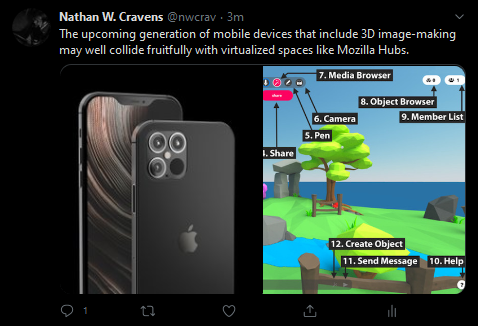
Mozilla Hubs, although intended as hangouts, the open source code may be useful for creating explorable 3D models of the real world, like the home or to better visualize supply channels based around a product, business, or government or monitor rewilding sites.
The folks from the Communecter project might also have some insights to offer about Nathan's proposal for a Public Resource Management System. @Julien Lecaille @Tibor Katelbach ?
AFAIK this is the latest code:
https://github.com/pixelhumain/communecter
Communecter looks like a great project. I'd love to connect and know what you think.

interesting
Thank's for your response. Yes, I've read 'Screen New Deal'. Regarding information, I am sorry, but I may not be aware of all the documentation you are mentioning (e.g. the business plan, etc.). I'm a newbie to this space :)
Regarding tools.. it depends on the use case, of course. In the Google Docs I saw only 1 page, view-only mode. So that could be contained in some kind of markdown doc, wiki or issue tracker, or even a markdown-based static site generator, without hosting costs. If collaborative editing is a thing, then there are also FOSS, and - I think - free hosted alternatives for that too. These may even export to .docx for those that only use that, otherwise PDF may be a common distribution format.
Interesting tools in the proposal, btw, I have to pay them a visit still.
I don't know the stance of people participating in this group, but I would be strongly in favor that all tools that were used project-wise and all the deliverables in code + documentation would have FOSS (preferably copyleft) and open content licenses. Please excuse me if this discussion did already take place. This can also be a 'selling' point to any of the cities approached with the concept.
Finally something about the proposal. There is a bit of mixing of concerns that could be given more clarity (maybe you already did that elsewhere). There is mention of the proposal creating a Loomio widget, other widgets, of the 'lead developers and projects onboard' (Loomio organizations?), a 'Docker for any project to join the ecosystem' (again Loomio, the new public RMS, local community project in general?). There need to be clear distinction between specifications / standardization (to be on the same page, not reinvent wheels) and implementation-specific stuff (where many projects make their own choices). WDYT?