Business Management Software
 Ed Russell PublicSeen by 45
Hello all.
We're trying to upgrade some of our business process software, mainly time tracking, project planning and work in progress - currently we're using a mix of of Trello, GIT, Slack, some Access system I wrote when we started 10 years ago, a web time tracking portal that tries to link it all together (that we wrote). It not brilliant though it kind of works (and makes sure everybody submits the right information / is working on work that they should (i.e. will get us paid) etc.
We are looking to put something in, or write something new. We'd prefer the former. We're happy (?) to pay money. It needs to link into Xero as that's our accountancy & invoice tracking (though we can write the integration ourselves).
So - what does everyone else use? What do you like about it and what is annoying?
Any suggestions greatly received!
Ed.
How do you find WFM? We looked at it ages ago but it seemed a little all over the place - though it is written by the Xero dev team so the integration will be good!

Hi Ed,
At Agile Collective we use Harvest for time tracking, Taiga for project management and Rocket chat for internal comms. The latter two are open source projects so can be self-hosted. We were going to develop our own time tracker but for a few reasons have decided to go with Harvest which is working really well for us. We don't have any direct integration between Harvest and Kashflow, our accounting software, but we don't see that as too uch of an issue for us. We also use Google apps for email, calendar and document management.
What we are looking to solve is our resource management process as we are currently using a spreadsheet. However, it's as much to do with process as it is with the technology we're using.
Hope this helps,
Aaron

Hi Ed!
I hope you're well.
I think Aaron covered most of it, but at Agile Collective we also use a self hosted Gitlab for code management, and a self hosted Open Atrium for support client issue tracking. We have basic integration with Harvest to track time on support tickets from within the issue, which is useful. We do see some limitations with Harvest, but until we have time to write roll our own the pros outweigh the cons.
I wonder if there would be any appetite for collaboration on an open source time tracking system that met all our needs and integrated with all the things?
Cheers,
Finn

Hi all
Great topic @edrussell
Our main internal tool is Plan.io (https://plan.io/) - a hosted version of Redmine, which provides us with issue/time tracking, wikis, repositories and IRC. We also work a lot via Google docs and Etherpads (via https://titanpad.com/) for document collaboration.
For accounting, we've recently switched from FreeAgent to Xero. Having some teething problems with expenses management...
We have a daily standup via Google hangouts (we have an App account) , having tried others such as appear.in
We tried to integrate Loomio, but found we were replicating discussions taking place in plan.io. As a team, we do not use Slack, Trello and - importantly - email to communicate with each other, although we have some clients who do.
Thanks
Steven
Hey Steven,
Thanks - I'd not seen plan.io before. I'll check that out :-)
Let me know if you need any help with Xero - we've been using it for a while now. Though we manage expenses centrally (so they get sent to a team who put them on rather than being self-uploaded).
Ed.

Hey everyone
We're spread across quite a few platforms at the moment but aiming to streamline a few within the coming months.
- Xero for accountancy (just moved from Freeagent, it was too small for the size of the business)
- Google Apps for calendar, email, Drive
- Loomio, not sure if we're using this to it's full potential
- Slack for internal comms/some comms with certain clients
- Toggl Pro for time tracking, we upgraded a few months ago from the basic plan. Implementation was a bit painful but it's going well now
- Copitch, this was created by Matt Parsons- still not quite finished but already looks great. His aim was to facilitate freelancer collaboration through shared responsibility by pooling skills/resources, identifying day rates vs budget and listing deliverables. We've just started to use it. Ideally we'll eventually have a button that connects Toggl to Copitch so that we can see how much time has been spent on each project alongside the rest of the info.
- Float for resourcing
- Wiki for our staff handbook

We're super keen to try to join stuff up.
Even if we all use quite different models it would be nice for new/younger co-ops to be able to take them off a shelf.
Let's arrange some systems workshops/demos/discussions for the event.
Thanks for starting this thread @edrussell this is a core topic and key area of potential collaboration and development I'd say.
I'm not a developer, but I get excited by plans/ visions like that outlined in this early document about Enspiral's plans for an Open App Ecosystem (see also related Loomio group here).
In a very similar vein check out this post on ideas for a Collaborative Technology Alliance.
I really think and hope that supporting and developing such interacting and integrated open source tools for "transparent, democratic, and decentralized organizing" (as Enspiral put it) is/ could/ should be one of the core focuses of this network.
A big part of our reason for organising Open 2017: Platform Cooperatives is to try to get the existing wider co-op movement in the UK to get behind such efforts. Help! :)
@edrussell @felixwave @aaronhirtenstein @finnlewis @stevenflower @kayleighwalsh @harryrobbins just as people who've so far participated in this thread I love to hear any thoughts you have on all this Open App Ecoystem stuff mentioned above? :)
@josefdaviescoates we're fully on board.
We commissioned @matthewparsons to create his Co Pitch product as part of the ecosystem. You can read about it here: http://outlandish.com/blog/freelance-collaboratively-introducing-copitch/
We've been talking to Enspiral about integrating it into the ecosystem. We have an internal tool which syncs co pitch to Toggl to co-budget which i guess is the beginnings of an ecosystem.
excellent to hear Harry :) I'd read that about Co Pitch but it doesn't mention open app ecosystem stuff so awesome to know there is a shared goal to build and integrate such stuff... mostly it seems (from lack of activity in related groups) such efforts seems to have (at least publicly) largely stalled :-/
Love to hear others thoughts on all this, especially ideas about how best to support and move such ideas/ efforts forward?
I think one issue is that each organisation needs a slightly different eco-system.
E.g. we manage our surplus completely differently to Enspiral (and different Enspiral Ventures also handle it differently) so there's no obvious Co-Pitch -> Loomio -> Co-budget workflow and you need some middleware. Fine for tech co-ops but problematic for everyone else.
When we talked to Enspiral about productising my.Enspiral we found that we probably operate too differently for it to port well, and that even things like different laws would be an issue.
If we want to get to 3,000 tech co-op workers in the next three years then I think we need to make it much easier to take a business/operations model off the shelf and better tools/ecosystems/workflows are key to that.
and it we generally want to able to relatively easily enable everyone to take control of everything (like NEF's new focus see http://neweconomics.org/wp-content/uploads/2016/10/BUILDING_A_NEW_ECONOMY.pdf ) then better off the shelf tools/ecosystems/workflows that enable one click co-ops of all kinds need to exist too... (we're saying the same thing, I'm just re-iterating it and pointing out that whilst 3,000 tech co-op workers is a great bold goal, of course that is still relatively small fry given the overall challenges at hand...)
The need is definitely there and it would be brilliant if this existed. As Harry mentioned, using a few of Enspiral's tools might be trickier than it initially seems because we do operate differently.
I think the first step would be establishing a common/agreed way to operate and then introduce/implement tools that fit this. When Matt was building CoPitch, he spent quite a while scoping out our needs which enabled him to understand an organisation of our size, but he didn't tailor it too much to Outlandish. His own experience as a freelancer was really helpful because just like us, he'll be using the tool.

Indeed, as @harryrobbins says ; 'fine for tech co-ops but problematic for everyone else....' interdisciplinary working is a challenge even for related disciplines - say design and code - let alone the full scope needed to fulfill the demands of a large project.
And it goes further, things change (increasingly quickly) within a given discipline too;
My previous agency worked with (creative & design) freelancers for many years - 14 years in what started as an in-house, fully employed studio had become almost entirely remote freelance - and along the way, even tho we were still developing 'marcomms', not only did the type of freelancer change (eg graphic designers became designer/coders) but also the way they worked (in-house to remote, long term to 'on demand' etc.) changed as well. This meant management, admin, HR etc was in a state of continuous flux.
It is exactly this sort of thing that's a challenge to creating an integrated platform management tool. Still, as no one seems to have cracked it yet, surely a goal worth aiming for... Forza! #coops

In many ways this thread mirrors some conversations I'm seeing other places. This thread elsewhere on Loomio - https://www.loomio.org/d/NA2zSBJC/platform-coop - and also a FB discussion I had with Daniel Harris (http://daha.co.uk) some while back - both sparked by the recent profile of "platform cooperatives" as a response to the extractive network capitalism practised by the likes of FB/AirBnb/Uber et al - talk about not building platforms, but creating protocols for cooperation.
To my mind this makes sense - common open protocols that enable efficient (low transaction cost frictionless) cooperation. Would such an approach then facilitate the emergence of a range of tools that could be plugged together any which way, to suit the differing - and as @roybrooks says constantly changing - business processes of various business models?
Would seem to be a sound approach...
think this is one of the main problems https://xkcd.com/927/
Yes, the goal isn't so much a singular "integrated platform management tool" but a suite of interoperable apps (that are interoperable because they all use shared protocols)

I agree about "creating protocols for cooperation", Email and HTTP are examples where this worked, interesting to look at these examples:
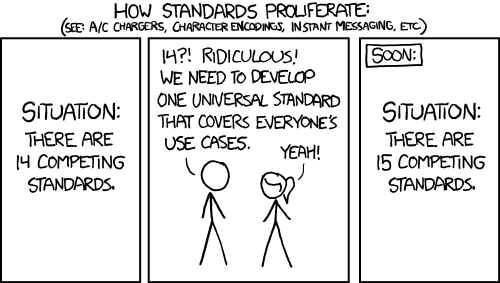
UTF-8 has basically solved the character set issue, USB for charging is on the way to perhaps solve the power charger issue, the instant messaging one is the classic example though, so many attempts have been made to solve that...
The last one I looked at, which I hope to have a play with, when I find time, is Matrix.
Hi all. So, isn't this a set of ideas that Poplus are actively demonstrating/sharing, via organisations across the world?: http://poplus.org/ (which could be built upon, both via code and concepts)
Poplus is an open federation of people and organisations from many different countries. Our joint mission is to share knowledge and technology that can help us to help citizens.
Indeed. Sandstorm also very interesting and promising, albeit taking a very different angle on things.
Sandstorm is a self-hostable web productivity suite.
I've played around with it a bit as an end-user (I'm not a developer) and have been suitable impressed: it's really great in lots of ways (single login to lots of apps, search across all of them, everything shareable much link how Google Docs are etc). Has got tasty technical things like capabilities based security baked in too.
I think it'd be a good idea to write down, first, what everyone needs.
I know from a CWEB perspective it's a lot about productivity tracking, profitability management, WIP management and on the fly resource management. i.e. the financial tracking that our accounts package doesn't give us and the scheduling stuff that we currently make up as we go along on Trello and whiteboards (massively high tech)... I don't think that'll be the same for everyone!
I am keen on a shared app pool approach, if we can make it flexible enough to make it work for all the different co-ops and working models.
Nowt wrong with whiteboards. It might be heresy to say it here, but there may in part be a tendency towards "the answer is more technology, what's the question?".
Oh, we love our whiteboards (one of our meeting rooms has each wall covered).
But managing a team and promising delivery dates doesn't really work so well :-$ Neither does it on Trello as we can't see slippage and update the plans dynamically...
We use WFM (WorkFlowMax) integrated with Xero; Gmail, Basecamp and Dropbox.
Less so; Google, EverNote & Whatsapp (internal IM only).