Sequence Generating
 Ronen Hirsch PublicSeen by 7
This thread is dedicated to exploring ideas around sequence generation and unfolding wholeness as an underlying theme that informs our work and vocabulary.
The theoretical meta-conversation, I suspect, can continue to diverge ... to be honest ... forever ... "the space was already there" - true .... now what? I felt and still feel that we need to be more concrete.
This is something very interesting. When I shared expansively my view on something we agreed to dig in I was not expecting to start an ontological debate nor expect convincing you but simply to let you know where I am. And regarding this concrete idea, precisely, because it does not have practical effects!
I would love to hear your opinion on this point: would you rather me sharing my thoughts on the human and the divine as I do now, and use your judgment whether you want to engage only if you feel that that would be generative, or it would be a better option to open a thread entitled "Toni's log" in which I let flow freely my thoughts not as a part of the conversations, but a place you can visit to understand "where Toni is" at this moment in relation to our work together? I would not like to introduce "noise" because of my way of communicating in the group.
I love the idea of you "hosting" a thread here on Loomio that's a place for your thoughts and thinking-out-loud, and where chiming in is welcome but it's also optional. I may do that as well when I have more time to get back into this space.
Let me start with (what I consider) the obvious: Please DO speak your mind and your heart!!! AND ... also hold the question of where/when!? A personal thread is one option, so is a thematic thread ... and sometimes maybe the place IS in context.
I try, when I find myself gravitating towards "abstraction" to ask myself: how does this inform the conversation? Does this enhance discernment? Does this create more subtle context and clearer choices?
To give a blunt example: when I taught systems analysis I built the course around actual projects the students were doing in another course. When everyone handed in their initial project proposals they almost all had something like this in the papers: "The system will be user friendly." So, in front of the whole classroom, I asked "is there anyone here who intends to create a system that is NOT user friendly?" Silence. So the statement "the system will be user friendly" is empty - it doesn't say anything and doesn't commit to anything. It needs more context and specificity: what would make THIS system user friendly ... that would be a promise that means something ... a guiding principle that would help in making decisions as you build the system.
I agree (and I believe I spoke this out during one of our calls) with the meta-notion that we are stepping into existing potentials (spaces) and not really "making them". AND this is a PRECIOUS vibe to acknowledge and inhabit together!
BUT!!! when it comes to establishing a digital space for strangers to discover each other ... when it comes to clicking the "New Subgroup" button on Loomio ... the meta-conversation is, TO ME!!!, a distraction ... an escape from a concrete unknown (a specific tangible choice we need to make - what is the first step in creating a remote-digital-space?) to a meta-known (a comfortable vibe-feeling where we feel coherent, seen and together in the notion that the spaces are already there).
My intention is not to be a "meta party pooper" :) My intention is to signal something like "this feels diverging and I'm not sure that this a good conversational-move right here / right now".
I have a feeling that I may be coming across (especially in async-written format) as more intense than I mean to be ... so QUESTION: how do you feel about me pulling in the "convergent" direction? am I pulling too hard? too soon?
admission: I am DYING to be authoring with you a generative process which has simple steps ... but where our meta-cognition will kick in and say "nope, before you do that you need to do this" or "this is too soon, before you can do this you need to do this" ... I am SOOOO curious to encounter all of your PRACTICAL insights from your ACTUAL experiences holding community spaces (which I DO NOT HAVE!) ... to address questions like Alex's "multiple people holding a space" WITHIN a SPECIFIC!!! generative process ... to allow the meta-insight to bubble into a specific reality ... to allow the specific reality to be informed by the meta and for the two to challenge each other ... SPECIFICALLY ... not ABSTRACTLY!
I have heard Ryan Singer (basecamp strategist) suggest that in many design disciplines designers are unconsciously seeking generative processes. When we don't have a generative process, we fumble around, we become conceptual, we procrastinate.
This feels like a gem to me! I've seen it, it resonates. When we don't have an adequate map, we stumble around and trip over the terrain. It makes me wonder what the fundamental generative processes are, or generative principals. Which schemas should be privileged when dealing with the unknown also arises as a question for me?
If we are lucky ... we will be able to say in retrospect: a space is what emerges when you follow this generative process.
So, is there a generative process (set of processes!) that could lead to more vital and productive spaces?
Well put, and a pointed exploration. What are the generative processes that create a space? Depending on how deep you want to go, this article has it all from the headings to the references. I'd very much recommend it, Dave always does his homework.
When I shared expansively my view on something we agreed to dig in I was not expecting to start an ontological debate nor expect convincing you but simply to let you know where I am.
@Toni Blanco - I'm slowly building my own site as an experiment to do just this; articulate and express my world view without having to reiterate myself all the time; personal aphorisms or mantras if you will. If you feel inclined, then Loomio is a good a place as any to start iterating; you can just link to "blocks" or comments if you wish to refer to your Ontology at some point.
So the statement "the system will be user friendly" is empty - it doesn't say anything and doesn't commit to anything. It needs more context and specificity: what would make THIS system user friendly
This feels like functional specs. I wonder if theres a computer science parallel with functional programming? I've a friend thats big on that paradigm - he's articulate and extremely precise and lean with his logic also. I feel its a good habit to get into; I've been known to take abstraction to ridiculous levels in search of the meta unknown though trying to ground myself more these days which I feel is getting there - still, old dogs ;)
My intention is not to be a "meta party pooper" :) My intention is to signal something like "this feels diverging and I'm not sure that this a good conversational-move right here / right now".
Poop away matey, as mentioned above I'm trying to get out of the abstraction so please feel welcome to jump in. Actually I think I'd like us all to do shoulder that burden.
so QUESTION: how do you feel about me pulling in the "convergent" direction? am I pulling too hard? too soon?
No, I think we've done divergent enough. I really appreciate this thread, it articulates many things I want to articulate in other groups, and its framed very well. Also regarding how the text conveys itself - I find it pretty neutral bar unnecessary emphasis in capital letters, otherwise its well formulated and clear text thats easy to interpret.
I am DYING to be authoring with you a generative process which has simple steps
Like wise homie. The proposal of grounding ourselves in experience when the meta reflex crops up seems like a concrete proposal. Lets go!
I strongly feel we need to find a way to "judo-flip" 🐬 our abstraction-tendencies into specific attempts at concrete processes!
Agree wholeheartedly! I've been thinking about this and feeling that part of my anxiety arose from thinking that there was going to be the beginning of "actually doing something" (which I remember as @Ronen Hirsch starting a thread to try doing a round of Sociocratic consent related to a proposal that surfaced at our last meeting) and not being able to find any evidence of that either in the HackMD space or the Loomio thread. So either I remembered it wrong or something isn't happening and either way I'm confused! I'm running out of sandbox time for today but I do like how this is starting to shape up as a tangle of things I can enter into (thanks @Josh Fairhead for the music recommendation for this round) and not a wide-open space that feels very confusing.
You're all really beautiful thinkers and it feels very good to drink up the wisdom that you've shared here. Next I'm going to try and respond to Ronen's prompts around work/effort/flow in more depth.
Just a quick update of what I am up to. I revisited all that we have documented so far since the invitation to crew, to have some perspective and refresh my memories (hey, not bad AT ALL!). Then I have been seeing the whole of the generative process, looking for/sensing the weakest as a whole, also through your eyes as much as possible (I found the theoretical digressions and divergences useful for that). I ended up with the idea that while money and care was a weak point (and partially addressed by the answers to this post), the weakest point (in my view) is that we all experience a lack of clarity of what we can offer to the crew to progress into our desired outcome for this cycle.
What I am maturating these days is what kind of intervention would be the right one (maybe the "judo-flip" that I guess we all expect or want to happen at some point), and how to find out, precisely, what each of us could happily contribute to it . Or in other words, how collaborative can be the intervention being, qualitatively at least, a kind of load that @Ronen Hirsch has carried (quite) alone so far? Should I step in as he has done so far? This question, in my view, addresses concretely and practically the inquiry of the definition of space we use and the collective holding of it.
Here are some of my hypotheses I would like to test in an intervention:
Every new cycle requires an explicit and written invitation as well drafted as the invitation to crew that Ronen wrote and that successfully brought us to a second cycle (even when it is only addressed to the same participants). It is desirable to reflect as much as possible the practical implications of the retrospective of the previous cycle. The "Seed for Remote Microsoldarity Generative Process" did not work as such. Task 1: I took as a template the first invitation of @Ronen Hirsch, and I started to draft the new one, keeping all that was still valid in my opinion and upgrading it with practical implications of the retrospective AND the conversations/exchanges we just had after our last face-to-face meeting together*.
As we practiced it, the sociocratic consent triggered theoretical questions that we did not want to address in the sociocratic form because of the cost/benefit we perceived. On the other hand, on the previous cycle we reached complex agreements without the systematic use of the sociocratic pattern, which makes me question the need for it for now (or the precise context in which it would be generative). (Caveat: since we did not used the sociocratic consent, we may differ on or overlook implicit agreements, but that could happen anyway when using the sociocratic consent). Task 2: initiate the sociocratic consent we agreed to follow to propose putting its use on hold until we feel we are in a situation in which it will be generative.
We are all "making an effort to set aside any considerations of actual implementation of our ideas", but our crew is at the end, somehow, a bootstrapping-kind-of implementation of our ideas. To document it as such would help us to refine our "final" outcome, by considering what part of the implementation (and how) should inform the generative process we are writing (and somehow experiencing) together. For instance, I reread carefully Ronen's proposal of the use of emoticons here and I think that it is incredibly sophisticated. To offer our implemented experience of a remote crew as a companion of the written generative process would be very useful (and alone by itself). Task 3: create the structure and the content of the document that shows in a concise and informative way the practical aspects of our crew.
The three hypotheses above sort of leads to a new one: the document "A Generative Process for Remote Microsolidarity" can be substantially enriched/improved with all the lessons learned recently**). Also, I miss some ideas that we seemed to agree on (relating to playfulness, etc.) during the first cycle. I know that it was only a draft and an initial offer of @Ronen Hirsch, but I kind of feel that a) the complexity of the documentation of the process distract us from taking care of the "baby" we have in our hands and 2) that complexity also adds confusion on how to individually contribute to improving it (at least, is clearly my case. Task 4: figure out the procedure to contribute to improving that document and make a first simple contribution to it, as a test of the procedure, and then see how to do the more complex contributions.
We kick ass. We will figure it out. Task 5: show my trust on the crew by hitting the "post comment" button and going to sleep. Now.
So I need time to figure out which one or ones of the tasks if any (besides number 5, which I will complete in a few minutes) could lead to a good next intervention and If that was a reflection to make alone or collaboratively. Any feedback on this update would be surely appreciated.
* I also think that would be powerful to add the common assumptions we are challenging or the hypothesis we want to test so we can connect more easily to what makes special this crew and how we can contribute to the definition of the generative process.
** Here I am assuming that we share some "pragmatic believes" (and I am using an expression of @Josh Fairhead) not affected AT ALL by our "theoretical divergences" that make us keep working together, and made us feel last week that we made progress. I had, anyway, some insights that I think could favor alignment in practical terms.
YES. Thank you for offering and holding this.
Clarification. I do not believe we've really practiced sociocractic consent and the main reason is that it requires clear proposals. I believe this is one of the most overlooked and critical aspects of sociocracy. There is a gap between meta-flowing-conversations and specific correctly sequenced!) proposals that can be put to consent. We have, from my perspective, NOT yet tried this.
Which raises the question: is a stream of proposals (which can be put to consent) a good strategy to collaborating on a generative process together? That was a working assumption in the way I setup cycle2! @Toni Blanco there is another tool (produced in your city of Barcelona) I considered using and did not offer - it may offer a softer flowing experience for collaborating on content. If you would like to do a one-on-one meeting I can introduce you to the tool (and if you would like to its maker) and let you consider if this is something you wish to incorporate. To be clear @Alex Rodriguez and @Josh Fairhead I'm happy to share this with you too ... however I have a feeling it may be better to first "vet" it through Toni and only then bring it to the group.
I had to HOLD MYSELF BACK from writing this document the way I would have wanted to BECAUSE I wanted it to be collaborative. Again, this is a specific choice and behind it an assumption (collaborative preference) ... there are other options we can explore here.
I am liking the feeling of leaning back a bit and watching you Toni take the lead and am curious to see where you want to go :) Please let me know If there is anything I can do to help. I am keeping the sandbox time open for Thursday in case you want to use it!.
Thank you a lot Ronen for send me your explicit support, let us see how the inquiry goes. Agree with you in 2. (we just simulated using it), and I take note from 3. that the streams of proposals was a working assumption ( + are you talking about Pepo? Still maturating, but I would like to hear about you intuitions on tools, despite I am a little Amish in that sense). Regarding 4. I wonder if writing the document that you had in mind BUT with the spirit of bringing it to a sort of sacrificial ritual (LOL) would have been a better option.
Anyway, what you seeded for this cycle I think is working, or at least we will see its results in the coming couple of weeks.
Yes, I am talking about Pepo and CollectiveOne. I connected with Pepo during my time in Holochain and was (I believe) able to make some contribution to the experiment that is CollectiveOne. We eventually recognized that collaborative writing was a fundamental need and that C1 had a capacity to tend to it in an original way. I don't know where the tool stands today but I do want to point out that Pepo and I developed some protocols between us about HOW TO USE the tool (including a consent process). Since the tool could not find grounding (=people who would try to use in real life) Pepo gravitated towards the more abstract "underscore protocol". Do you know Pepo?
.. and for the record :) I treat almost everything I create (within this crew and beyond it) as sacrificial ... in the case of our crew to be consumed by our small tribal fire ... and if you put too much wood into a fire all at once you can smother it ... a good fire requires a good mixture of heat fuel and air. I didn't want to smother our fire ... it is still a small and delicate fire it needs care so it can come to burn reliably.
Thanks @Toni Blanco, that must have been a lot of reading! But I think you've brought back some fine fruit from your foraging encapsulated by the following sentence:
I ended up with the idea that while money and care was a weak point (and partially addressed by the answers to this post), the weakest point (in my view) is that we all experience a lack of clarity of what we can offer to the crew to progress into our desired outcome for this cycle
I'd say that it's fair, but more in that we don't really know what is desired as an outcome for this cycle. Is it practicing Sociocracy, honing a generative process to seed space, is it to enable more people to participate with us in something yet undefined? Riffing off whats already been posted above, I think all of these tasks are somewhat abstract while disguised as concrete actionables - maybe I'm wrong though?
1. Good stuff man, I'm curious what emerges.
2. I value consent, but the sociocratic form maybe not so much - when theres is coHEARence and we are tracking eachother and minding our impulsiveness its fine to do without IMO, but its a good failure mode otherwise. It seems reasonable in larger groups or when we feel a need to play pass the talking stick but so far in that regard I think we've been pretty civilised. That said, something that requires concrete action is maybe a different story as Ronen is suggesting below.
3. Sounds just like a handbook.
4. The original doc is pretty abstract so hard to hold in our heads until it's been practiced a number of times, I feel it's pretty intuitive aside from that though.
5. Lol, hope you had a fine sleep 🤘
@Ronen Hirsch
I am talking about Pepo and CollectiveOne
Oh, small world, I know Guillem that side and met Pepo at the Holochain hackathon in Barcelona as well. I'm not sure what the story is around C1 but _prtcl is still in progress as far as I understand it. I believe Guillems community building while coding away.
.. and for the record :) I treat almost everything I create (within this crew and beyond it) as sacrificial
Amen brother, I can pray to that alter as well. Same thing for the fire, hence not responding much last week, felt I added too much fuel the week before and am maybe doing it again now... finding equilibrium with our dynamics still I reckon.
Approaches
I am still working on the self-orientation post. In the meantime (and this is a sort of chunk of it) I would like to share some brief reflections on sequence generation, to further develop if interested.
The Christopher Alexander Way
From what I understood so far, Christopher Alexander first does some research/ethnography to identify some “living centers” in existing examples of what the sequence intends to build. To describe these centers, he designs a “pattern language”. So this is 1) how you feel “the whole” and 2) you can think/talk about it.
CA writes: “Each pattern is a rule which describes a type of strong center that is likely to be needed, on a recurring basis, through a particular environment or class of environment. Further, a pattern not only describes a recurring center, but also describes a relation between other generic centers. In some point he also explains the story about how he asks that couple to close their eyes and remember/visualize the place which made them feel more comfortable and this way they together identify the most important place of their future house.
My first hypothesis
In the context of our experience, I thought that I could understand the second cycle as the identification of centers and patterns that made (and make) us crew, for if we exist as a crew so far is because there is a generative process underneath. So this could be a matter of reflecting and documenting them, and refine the sequence according to our learnings. That idea did not stick in the group (although I still like it and save it for future experiments).
My current hypothesis
Now I am more in the sense that talking about matters of concern such money and care will lead us to identify centers and patterns, and once we have them, we will be ready to write down our generative process.
Some centers (with no clear pattern yet) that seem to emerge:
Invitation
Agreements
Written sense-making and decision space
Face-to-face orientation space
Written self-orientation space
Back-channel
Signaling of interest protocol
Offers
Proposals
Face-to-face support
Face-to-face sense-making
Audio doors into spaces
Shared silence
Ethical income generator
Thoughts?
@Toni Blanco while writing my response to the money and care thread I had a crystallisation.
Aristotles 3 types of friendship
Transactional (low trust: exchange - zero sum)
Hedonistic (medium trust: mutual enjoyment - neutral sum)
Spiritual (high trust: care - positive sum)
Flow
Whats interesting is that societally it often flows:
Transactional> hedonistic> spiritual
Implicitly we've been doing this in reverse:
Spiritual> hedonistic> transactional
@Josh Fairhead this is interesting, and now I wonder if a microsolidarity online platform should be able to let people flow in the path that feels more comfortable to them, instead of forcing one by design. Also if different friendships can be present simultaneously in a group (in different intensity), so the crew has to modulate the right mix. I guess that we naturally flowed initially to the spiritual because the four of us are committed to a spiritual path, but this does not have to be the case for everyone.
I will (try to) keep this brief:
I am enjoying the maturing thought process ... and finding centers can be a good practice.
I feel that this direction is somewhat informed by some of the things we talked about @Toni Blanco in our one-on-one conversation and that we are not yet caught up on as a crew! So that (catching up) I feel should come first (hopefully next week in gathering 9).
With that said ... listing centers, while a good practice, is also, I feel a step into a mechanistic thinking trap. A list of centers can create a gravitational pull towards thinking about "how to assemble" those centers into something whole ... and assembly is NOT unfolding!
I do appreciate that in all the work we've put in so far we've identified and explored an implicit list of centers (and possible patterns) ... I feel better about that "list" staying implicit until it becomes explicit through an unfolding (and not through direct listing).
It is useful, I think, to remember that the challenge we are facing is a meta-challenge. If to use an architectural metaphor it is not about designing a house but about HOW to design houses. Listing centers may work when someone else has answered how to design houses and you are designing A house.
My curiosity is about trying to unfold a generative process and discovering what centers emerge.
I intend to pick up this thread AFTER we are all caught up together :)
I kept reflecting on my petition for putting on hold our work, and while there was disorientation as we frame it in our last 1-1 conversation, I recall that the trigger was the genesis of this thread and the thread itself. In short, I was concerned about our work perceived as stuck and not valuable enough by some of us, entering the path of low participation of the general microsolidarity Loomio. So I guess that I tried to unveil/find/show/propose a more clear way to our desired outcome for the cycle.
Not that now is vital for our crew, but maybe working on this thread can reinforce it.
If anyone would ask me how we are working now towards our goal, I would say that we are letting dynamics and topics emerge according to the needs of the group, because needs are somehow the anchors of centers/patterns. And at some point, we will feel that we have enough material to reflect on (because of a qualitative leap in the maturity of the crew/conversation). Then, and not before, we will work in a documented "generative process".
I think that there may be something to the "spiritual-->hedonistic-->transactional" pathway that has particular relevance for a remote crewing generative process. I'm thinking this because I don't think that transactional relationships can actually serve as the "spark" or entry point into a genuine crew in a remote context---maybe in the context of a community or congregation "already on the ground" so to speak, but I am having trouble thinking through what that could even feel like in a remote context...
Item removed
When we try first to work collaboratively in the crafting of a GP we set up a decision-making protocol. It did not work, because it was not generative. It was not a strong center because it was not what the wholeness needed at that moment. It was probably answering to phantoms of the past of previous collaborative processes. Then I proposed another path to work, based on our own generative process as a crew. It did not stick. The idea was to keep a track of the transformations in the wholeness of our crew, and then inferring a generative process for an space from it. I was so insecure about it that it never made it to Loomio, so you have to go to 11/28/2020 in Discord to consult it.
The driver of the proposal was to work on something we all were experiencing and observe as it unfolded. Ronen pointed out (rightly) that the space created for our crew had a different purpose than the one we were intended to create. Therefore, working in my proposal would help to work together in a GP, but in the best of cases would lead us to an “intermediate" GP that would inform the generative process we were actually looking for. As I told you, I still think it was a good idea; maybe poorly executed. Ronen was also right when he said that collecting and listing possible centers makes it too tempting to treat them as pieces to assemble, which goes in the opposite direction of what we are supposed to do.
By then, I accepted Ronen’s frame that my proposal was caused by my disorientation, but now I think that personalizing that disorientation was misleading. The best way to orient yourself in a space is by watching what others are doing in that space, but that did not help at all. I think the rest were disoriented as well.
I did not insist on the proposal, despite I thought it was a good proposal because it was not generative (and mostly because it did not trigger any reaction positive or negative from Alex a Josh.) In perspective, it could have been a good training process, so I will refine that idea taking into account the learning of the present and future cycles...
On the importance of the context of the GP
It took me two things to grasp what Ronen was after for: the example of the " Starter Cultures" as an example of the space he envisioned, and his description of such space at Collective one. With that in mind, looking back, all my "disorientation” appears in a different light. I am curious to know about the rest of the crew. Maybe it was me, lost in translation... I have to say that what I had in mind was a different space. Maybe less specific in the details, more open to different possibilities (participants, funding models). What Ronen has in mind has a target audience, and a concrete financial model implied. No wonder why any suggestion I made to the cards, that intended to open different financial models, were not taken as contributions to strengthen the wholeness but the opposite. In the meantime, I decided to write a generative process of a well-known domain, one that I have been putting into practice during the last three years with my partner Sergio. All the reflection and the experience helped me to perceive the wholeness. Ronen offered to give me a hand, and I was looking for the right time for that. The situation acted as a mirror of the process but with switched positions. And I see this very clear now: in order to work in a collaborative effort of crafting a generative process, a lot of context is needed to everybody have a shared perception of the wholeness.
A way to collaborate seemed to emerge organically in order to overcome the lack of shared context and the different knowledge on Alexander's work. Jennifer started to write her own version of The GP, which inspired Josh to do the same, and vanished my worries of doing that, as I was afraid that would be perceived as a defying "fork” (and implying a petition of "passing the stick"). Comparing versions of the GP helps to increase the shared context, the know-how of writing a GP, identifying weak or untended centers, or better orders in the sequence. An additional consideration is that it is not necessary that all the members of the crew excel or even have the skill of writing formally a GP. Actually, one is enough to guide methodologically the rest.
Taking the example of the dissonance of the word “financially” in the description of the crew. Simplifying a bit to keep this brief, if Culture Starters is the closest model of what Ronen had in mind for the space, you have to pay attention to the people that hold the space and the participants attracted to the space: mostly young overeducated people in advanced economies that do not want to work in corporate environments nor in traditional hierarchical or poorly paid positions in NGO organizations. Entrepreneurship “a-la-microsolidarity” is the answer. One of the things that those spaces somehow are failing to do is the financial sustainability side of the crews, (but for the ones that manage the space). In this context, Ronen’s insistence on the importance of the “financial word” in the description sounds like a good move, (so the marketplace as a beta testing space of entrepreneurship). Without that context shared, not even agreed, that is not possible to grasp. Choices are called choices because they include some things (i.e. collectives) and excludes others.
How to share context while keeping the wholeness (together)
Very recently I found this text in a serendipitous way. Looking for more texts of this author, I found much more material, and I experimented with some of the ideas I found. The most interesting to me was this one, which describes a practice that I adopted for working in my GP: drawing an egg that captures the strong centers and main sub-centers while keeping the wholeness. I tweaked a little bit of the process described in the paper.
When I started to feel the wholeness, I perceive that I had a lot of ideas pushing and competing. This is important! Oh, this is also very important! And so on. I also noticed the pressure of linear thinking. What is first? What comes next? So I decided to put the egg aside and write everything down, non-stop. Spit out everything. Then, I told myself that I could rest easy and be assured that nothing important would be left out or forgotten, every key idea was written down. And I came back to the egg.
Then I followed more or less the instructions. I let the strong center emerge. And then the other centers that supported that centers. I thought of sub-centers supporting the centers. Every step I felt how it supported the center. I let that first version rest for a couple of days. I enlarge a sub-center as a center, and I completed sub-centers. I let that version rest again and slept on it. I let it grow in me and felt its wholeness. I changed some wording. I never felt the need to read what I wrote down. I did not analyze the kind of transformation (the major 15). This is how my egg looks like:

When I felt that it was a good egg, I went back to the initial notes with curiosity. Nothing essential was left behind. Most of the things I wrote were not that relevant for the egg. So it was at the end, just noise. I thought a little bit about the centers and how they were related. I recognized some of the transformations of Alexander, but I mostly used another perspective, a trivalent logic I learned from René Thom and Gilbert Durand that I consider simplifies a bit the classification of the 15 transformations but captures the spirit. (I offer an introduction to that trivalent logic if you want to know more about it).
I imagine doing the exercise collaboratively as a way of sharing the context at the same time that some centers are identified and shared before moving to write cards. Or even share individual exercises of the egg.
For instance, take the case of very asymmetrical knowledge of the domain, like the one I am working on now by myself. Explaining the egg above to the crew would force me to explain the wording, the rationale, etc. of the Pantheon Work Framework. (I am pretty sure that it could be improved and refined with the ideas of the collective. But that was not the aim of the exercise, but learning what I am sharing in this post).
On the generation of a generative process
I realized that it is a quite different thing to write now the sequence, when I have seen a bunch of beautifully functional teams that adopted the Pantheon Work framework, and the first time we introduced it to a team. And I think that is not very different from how Alexander’s wrote the GP of the Japanese teahouse, and how that “ideal”, archetypal I would even say, Japanese teahouse was developed with the passing of time, by identifying needed centers, by trial and error, etc. If we are writing the GP of our remote microsolidarity space as it existed is because we all agreed that our space would not be radically different from other spaces, but a tweaked one that solves the current deficiencies.
How to write cards while keeping the wholeness together
When I decided to translate the egg in a sequence of transformations (written in cards) I encountered again that context was important. I had two scenarios in my past experience (some teams/organizations had formal hierarchies and others didn’t). And I foresaw a new scenario that maybe I will try in an entrepreneurship university program: new interdisciplinary teams must be created for the course, from scratch. So, any GP implies some initial conditions. For instance, in the Japanese teahouse, we have a terrain plain and empty. That would be a non-hierarchical organization/team. If there are hierarchies above the team, I have an extra transformation (step) to “clear the terrain”.
Looking again back in my past experience, I started to play with implied conditions that could be met or unmet. Also, a generative process could interact with other GP. I remembered that Alexander said that the GP where mathematically limited in number, (but not limited to one).
I wrote some titles of initial transformations. I ordered them. I wrote two different GP, depending on different initial conditions. I merged them, and draw a pattern like this:
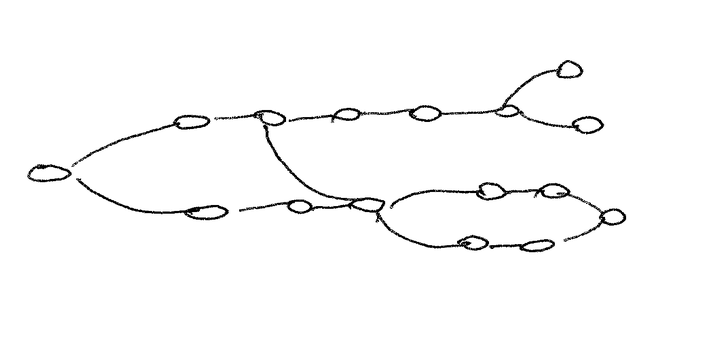
I worked again. By writing more generic transformations that included the ones provoking a bifurcation, I was able to keep a single GP. It gained simplicity and lost detail. So the alternatives are losing detail, or make explicit the initial conditions.
So I consider that by making explicit the essential initial conditions, and working with the egg, a group can work either sync or async in a GP, following the logic of what comes first that cannot wait for later and contributes to the wholeness.
(I am working now in developing the titles of the transformations -cards-by writing a text as long as I want, then highlighting keywords, and rewriting a shorter text).
On the possibility of working with audios
We have learned that sharing audio instead of text was good to connect emotionally with the GP. Reading overemphasizes our analytical mind. By listening we seem to activate our imagination and our aesthetic mind, getting better "the big picture”, and overcoming the temptation of not paying attention to counter-intuitive and paradoxical realities.
I imagined the experiment of recording myself talking about the transformations, then listening to the recording, and finally writing the text of the transformations.
I discarded it because I did not have the conditions to do it, but I think that I will try it when possible.
Context of the GP
The context of the GP has been and continues to be clear in my mind, and I believe true to the invitation for this crew: converting a random stream of strangers into cohesive crews.
How would you go about creating a more refined sense of shared context? My implicit question was: could collaborative authoring of a generative sequence be a good way to discover, communicate and collaborate on a shared context? When we could not find a way to actually do (take coordinated action) this together, I embraced the "sacrificial invitation" and ... well here we are :)
Financial Models
Starter Cultures is one example. The Stoa is another example. Warm Data (Nora Bateson) is another example. Microsolidarity itself is another example.
I do accept your framing of StarterCultures as a good example of where a financial model may be clear. I do not recall rejecting other "financial models." It was my conscious intention to altogether bypass any commitment to specific financial models. I was seeking an underlying "generative operating system" where different financial models could manifest. I recognize (and have spoken out and asked to be called out on) my own biases around this subject. The Value Agreement generative sequence is an attempt to do just that ... an accounting method that could be used to explore and implement many financial models. I believe that becoming consciously aware of value flows is fundamental to this effort. Beyond that, I have tried to shape value agreements in such a way that they could hold many financial models (payment, subscription, gifting, funding, etc.)
Methodical Feedback on Generative Authoring
I feel that I can offer feedback on the "generative authoring" regardless of the domain that is being expressed. In fact, in a way, the less I know about the domain/subject matter, the easier it may for me to provide feedback because it is (in my mind) the responsibility of a generative sequence to lead me towards clarity.
Emotional Work / Friction
"I was afraid that would be perceived as a defying "fork”
This, I believe, has been a major inhibitor. I feel I have done everything I could on my part to disarm this notion.
I am experiencing some discomfort and friction with the following framing:
"In this context, Ronen’s insistence on the importance of the “financial word” in the description sounds like a good move"
First of all, I don't feel it is correct to say that this is "Ronen's." Money was not originally a part of the generative whole that I had in mind. Money became a priority after our intimate conversation about money from which I got a sense that addressing money well was important to the crew and to the people that may one day inhabit the spaces we are imagining.
Second: "insistence" - I would really like to know more about where this is coming from. If this is, coming from you, a manifestation of communicating in English, then there is nothing to it. Otherwise, there is something here that I want to understand. Insistence is not a strategy that I employ (at least not consciously). I don't recall ever insisting on it. I do recall immediately paying attention and making space to explore it (and ultimately remove it) when Jennifer expressed dis-ease with it. I am sensing something shared between your response and Jennifer's ... I am sensing a reactive response from both of you ... and since I seem to be the trigger, I want to know more about it.
Also, in my mind "insistence" and "sacrificial" don't seem to make sense together for me!
Forking
I do agree that forking is a great way to explore this kind of collaboration. Make your own copy and start changing it and see what works for you. I have tried to integrate this (and other insights from our efforts to collaborate) into MetaGen.
The Egg
Thank you for sharing this Toni. Before I actually relate to "The Egg" and to "Your Egg" I want to express my amusement! This seems to me like such an obvious experiment that in my mind it hardly deserves all the fanfare of an official academic paper!
As for The Method of the Egg:
I understand the visual appeal of expressing ideas this way ... the apparent perception of wholeness it may evoke.
That appeal is quickly eroded for me when I attempt to express myself this way. I feel that I have too many ideas that are way too fluid to mess around with trying to contain them in a drawn egg. Maybe it could be more useful if there was a digital tool that allowed the egg to grow and morph as its contents take shape.
That appeal is also quickly lost on me when I try to "read" the egg ... it is exhausting.
The format only makes space for the "title of the centers" and no space for an elaborating description ... for me the titles are not enough!
It invites more recursion (things inside each other) and less linearity. I don't feel that recursion is helpful for understanding context. The Japanese Teahouse is a single linear sequence.
Sequence seems to be an absent dimension in this view ... and I believe wholeness is not possible without VERY good sequence
My impression is that many people are drawn to centers and 15 transformations and patterns from Alexander's work and that Generative Sequences (ie the Japanese Teahouse) are one of the most overlooked insights he has to offer.
I get it that the "egg" looks like a whole ... and maybe it is a good metaphor for teaching and talking about wholeness. But I don't feel it is a good tool for exploring wholeness.
Ryan Singer on Figuring out what to do
I encourage you to look at this post (and if you are interested, at follow-up posts) from Ryan Singer:
https://world.hey.com/rjs/13-beyond-to-dos-3cc8dd13
He demonstrates different transformations he uses to deal with a challenge that I believe is similar to yours.
I like his work very much, but I believe that he has a tendency to make things a bit too complicated in his attempt to find methodical patterns. In the end, he seems to arrive at (though not to recognize it as) a generative sequence:
"Okay — I'll set up the Calendly event, compose the recruit email, send that for review, and ... while waiting on that ... start on the last recruit steps and pick the email tool for blasting."
I am curious if it is possible to do the same work without "sifting & hunting for wholeness" but by "starting from wholeness & evolving it."
Your Egg
The title "Wholeness and Centers" is not very helpful to me. I prefer a title telling me what this is .. such as "Pantheon Framework for ..."
Is seems to me much easier to read and comprehend if presented in a boring linear sequence like this:
Federation of Competencies
Value Generation
Knowledge Flow
Agreements
External Signaling
... and I didn't have to decode handwriting, zoom in or out, or turn myhead on its side a single time to read that!
Additional sequences can be linked for each of those as centers.
"Explaining the egg above to the crew would force me to explain the wording, the rationale, etc. of the Pantheon Work Framework."
In my mind, if you need to explain yourself, then the artifact has not yet reached a generative quality!
Collaborative Exercise
Despite everything I've said about "the egg" I am open to doing a collaborative exercise if you wish to facilitate one.
Time and Collaborating on Generative Sequences
I agree with you. I think that the Japanese Teahouse sequence was actually created over centuries ... very slowly. Every teahouse that was built was an instance of a sequence and slowly, over generations it responded and changed (and probably forked!)
I recognize that the pace of process evolution that I am aspiring for is not as "natural" like this ... and I still don't know how to do it well ... and I continue to feel that learning to do so is a valuable skill.

@Toni Blanco I have a question.
You wrote: "Jennifer started to write her own version of The GP, which inspired Josh to do the same, and vanished my worries of doing that, as I was afraid that would be perceived as a defying "fork” (and implying a petition of "passing the stick")"
My question is: Are you saying that you understood the cards I wrote on Solidarity were meant to be my own version of the Generative Description of the Digital Space?
In case the answer is yes, I would very much like you to know that wasn't my intention at all, and I'm sorry I wasn't more clear about that.
My purpose was to write a description of a group of people practicing solidarity. I wanted to do that to make it clear to myself first, and I shared it with all of you so you could also understand my thinking as well.
I didn't intend it to necessarily have much to do with the Digital Space, because I'm not sure whether the crew intends to be a solidarity group as I understand a solidarity group, and that's fine with me. I also am not sure if the crews generated through the digital space are intended to be solidarity groups either (as I understand a solidarity group), and again, that's fine with me.
@Ronen Hirsch wrote: "I am sensing something shared between your response and Jennifer's ... I am sensing a reactive response from both of you ... and since I seem to be the trigger, I want to know more about it."
I want to clearly and concisely explain why I was triggered.
When I received the Generative Description of the Digital Space, one of the few things I knew about what I was about to receive was that it contained the word "solidarity." Due to that word, I had certain assumptions about the work.
When the experience of the Digital Space was generated in my mind, it was in the context of understanding it as a work to support and generate solidarity, as in the solidarity economy, which I have spent some time studying and trying to understand.
According to Ripess, this is the definition of the Social Solidarity Economy:
The Social Solidarity Economy is an alternative to capitalism and other authoritarian, state- dominated economic systems. In SSE ordinary people play an active role in shaping all of the dimensions of human life: economic, social, cultural, political, and environmental. SSE exists in all sectors of the economy production, finance, distribution, exchange, consumption and governance. It also aims to transform the social and economic system that includes public, private and third sectors. SSE is not only about the poor, but strives to overcome inequalities, which includes all classes of society. SSE has the ability to take the best practices that exist in our present system (such as efficiency, use of technology and knowledge) and transform them to serve the welfare of the community based on different values and goals.
(…) SSE seeks systemic transformation that goes beyond superficial change in which the root oppressive structures and fundamental issues remain intact.
These statements from their website also resonate deeply with me:
In the last three decades, there has been an explosion of solidarity-based economic practices around the world due to a range of reasons including,:
An increasing number of people throughout the world are experiencing deteriorating living conditions and deepening poverty.
With the logic of capitalism, people and society become resources to be exploited. Their value in the form of labor or social relationships are reduced to their worth in maximizing profits.
The deep environmental degradation, provoked by an extractive, intensive and extensive linear economic model, leading to widespread pollution and climate change.
In this context, grassroots solidarity-based economic initiatives have emerged rediscovering timeless practices and cultural traits, renewing and adapting them to the current context through the use of new technologies and other contemporary, regenerative and resilient resources.
When I realized that the Digital Space wasn't actually intended to be in alignment with Solidarity Economy principles, I was upset. I was upset at myself for having the assumptions which led me to be inaccurate in my understanding of the purpose of the project. I was also disappointed that the experience of the space that had been created in my mind apparently wasn't the same experience as the creator's experience of the Digital Space.
I also was triggered because it felt to me that since the purpose of the Digital Space was to bring people together to do meaningful work that was financially rewarding, it was continuing with the logic of capitalism: people and society become resources to be exploited. Their value in the form of labor or social relationships are reduced to their worth in maximizing profits.
And few things anger me more than patriarchy and capitalism.
However, I've had time to reflect and shift. I'm not upset and I'm not triggered anymore.
My experience of the Generative Description of the Digital Space is beautiful, as it is, no matter whether the card with the word "financial" is in the description of the crews or not.
If we are able to actually create that Digital Space in the real world, I think we will have created something generative and practically useful for many different purposes.
I have no idea how to go about building it in the real world. I want to see it built and I will work to see it built.
The original experience (in alignment with the Solidarity Economy principles) I had when I first received the description of the Digital Space is what I deeply want to see built. But in order for that to happen, it's quite possible that the Digital Space as has already been described needs to be able to be built in the real world, FIRST.
We don't know how to begin to build it. Knowing how to create a Digital Space that transforms random groups of strangers into cohesive small groups who are doing meaningful work that generates income streams while prioritizing mutual care is a good thing to do. If it needs to be done in alignment with capitalist logic right now, so be it. I am supported in my life by that capitalistic logic at this moment, since my basic needs are met due to my husband's skills that are valued by the capitalist system we live in.
Thank you again for the opportunity to be here and to contribute. I'm grateful.
I remembered another idea from Alexander that I believe reflects on The Egg.
Alexanders points to written processes in early design phases and warns about using drawings (even just doodles) too early.
If, for example, I say to you "imagine stepping out of your house, looking to your left, and seeing a tall building" ... that TEXT generates an image in your head ... but if I make a drawing I have to make specific choices about things like scales and distances ... and these can become unconscious design decisions that are unnecessarily forced ... and they may preempt the generative capacity because they force a choice over whatever may be generated in people's minds.
The shape of the egg introduced some biases ... the top is narrow and feels lighters, the bottom feels more massive and heavier. Are such qualities projected onto the contents that you place in it? Do the sizes of internal centers indicate weight/importance/complexity? Are things that are placed to the side secondary? Do things on the bottom come before things on top?
Drawings tend to introduce many conscious and unconscious biases ...
... something else to consider from a methodical perspective!
Item removed
Item removed
Than you for the clarification. More than a "fork", I would say that I though that it was like a "pull request", like a proposed alternative to be considered. But now I understand that it was for articulate a personal description of a crew practicing solidarity.
My reaction is related to what @Jennifer Damashek says. My main interest in creating a digital space for generating solidarity crews was to replicate it for promoting congregations of microsolidarity to boost what it is usually understood as SSE. As I think I mentioned, I was interested also in more friendly way of entrepreneurship for women, and for people in risk of social exclusion. Although (or even better, because) I am very connected to the SSE in Barcelona and I know its upsides and downsides, I do not use usually their narratives and wording, even more when they are framed as alternative economies. Long to explain. Let us just say, for starters, that I would prefer call Antisocial Unsolidarity Economy to the mainstream economy, and Economy to what the SSE pursuits.
The invitation of @Ronen Hirsch is vague enough to admit that vision. But I learned / was reminded when commenting cards that the space did not envision any kind of relationships between created crews, which I think that makes the space lose strength but oh well, this is still a project and a crew I am interested in. How money is articulated in the GP seemed to move it away from possibilities I know from the SSE and ways of funding. I tried to introduce some concepts and words to keep an open view on the subject that admitted more scenarios. And I didn't like the "financial" and "pricing" words in the cards because seemed to orient/lean the space to the Antisocial Unsolidarity Economy.
I have not read that text but I suspect that Alexander is talking about sketches of forms that prefigure the spacial configuration to be constructed. I see that it may sense. But I do not agree that applies to a workshop or a digital space. There will be biases in any form of expression, and writing is one of the most important. As you said, a written list implies an order. Of importance? Of sequence?
Now, the image of an egg, In super-short-simple. The eggshell delimit the wholeness. The yolk is the main center, and the white around is what supports the center, as other centers. Every new subcenter supports the existing main center.
I have been using today again for another project, and I love it.
Regarding the set of cards you created: they (and the ideas they represent for you) have not (yet!?) been discussed or integrated into the GP. My recollection is that we agreed that you @Toni Blanco own this thread of exploration, that it deserved a conversation of a dyad or possibly more participants, that it was up to you to initiate that conversation when you were ready for it, and that hasn't happened yet. Maybe the upcoming gathering will give rise to this. If not, please do make this happen.
Regarding relationships between crews: We have also touched on this lightly (once or twice) and the subject of crews connecting has not been explicitly explored because:
There is a soft container in the form of the space itself.
There is another soft container n the form of the structure as a whole.
There are other soft containers in the form of participant groups (participate in activities together). These may be precursors to crews but may also create other links and relationships in the space that may bridge crews.
There are other soft containers in the form of Skill Groups (all the people who over time trained in a given skill) that (by definition) grow over time and may also seed other types of connections.
I feel that reaching further into relationships between crews, at this time (when we don't yet know how crews will come together) would be a hypothetical over-reach in the context of this work.
Having said all that, if the subject of relationships between crews IS tangible and clear to you, then please do find a way to incorporate it to the GP. I am available to help with that in any way I can.
Regarding the set of cards you created: they (and the ideas they represent for you) have not (yet!?) been discussed or integrated into the GP. My recollection is that we agreed that you @Toni Blanco own this thread of exploration, that it deserved a conversation of a dyad or possibly more participants, that it was up to you to initiate that conversation when you were ready for it, and that hasn't happened yet. Maybe the upcoming gathering will give rise to this. If not, please do make this happen.
I am attentive to the right time to do it. The upcoming gathering looks like a promising opportunity.
Regarding relationships between crews: We have also touched on this lightly (once or twice) and the subject of crews connecting has not been explicitly explored [...] Having said all that, if the subject of relationships between crews IS tangible and clear to you, then please do find a way to incorporate it to the GP. I am available to help with that in any way I can.
Yes, I think that we convened that this topic would be tackled if needed. I accepted the premise of focusing on crews formation in the digital space, and observe if the GP demands it. I mentioned it to @Jennifer Damashek as an example of something that clashed with my initial expectations. However, it might deserve a conversation, for I think that how that topic is usually conceived is related to the different limitations and struggles I have noted at communities such as Ouishare or Enspiral. Richard's circle void>individual>dyad>crew>congregation>crowd>... is quite misguiding in my opinion, and reflects the problem I see.
Thanks Ronen, I will read the Ryan Singer post.
Regarding your comments on the money/issues, our forthcoming gathering is perfect to talk about them.
Regarding the egg, this is the whole point. Context. When done in a collaborative way, context is shared. I did it alone; context is not shared. But If I show it to Sergio, it will be generative because we share the context. If I explain it to you, I find a natural way to share the context.
Ryan Singer demonstrating some of what is mentioned in that article in a hacked application:
Thanks, I read the post. It is quite similar to techniques I learned from my mentor, which was trained in Metaplan. I use them a lot! I am not a software developer but I use Gephi for generating the graphs I need for identifying centralities in any kind of networks.
@Jennifer Damashek when you get to ingesting and relating to all the comments that have been left on your cards, I would like to ask that you be attentive to not just their content, but also to the experience of meeting them and how they affect your ability to tend to the wholeness of the process as you feel it.
The comments feel to me like many small fragments that are sprinkled all over the process ... and I am curious how receiving them will feel to you and if/how you assimilate/integrate them into your work on the generative sequence.
@Ronen Hirsch thank you for your guidance on how to process the cards that I wrote with the comments left there. I just spent some time reviewing them. Right now, what stands out to me is the comment you left on the first card. I appreciate that comment and I feel what I need to do next is create the container, define solidarity and my purpose for writing the cards in the first place.
If you are up to it, I would really appreciate it if you kept a kind of log of how you ingest comments, reflect on them and how they affect the sequence, what kind of changes you make (small/large edits, new cards, deleting, change of order), time you spend away from the sequence to reflect, feelings of stuckness ... anything that arises in your awareness as you respond to the inputs you have received.
I would be happy to do that. Where do you suggest I keep that log? Do you envision it as a text document where I simply record what I am feeling and doing? Could you help me understand why you would appreciate me doing this?
As part of what you are asking, would be helpful to somehow save the original version of the cards?
Any way that is comfortable for you ... and later shareable. I imagine a spreadsheet may be useful to create discrete entries and maybe add columns to suit your needs. It can be a google-sheet if that is your thing or an ethercalc if you prefer an open-source alternative.
Or it can be a paper ... or a text document ... really whatever works and flows well for you.
I am not able to figure out how to move cards in Collective One so that the cards I want are at the beginning. I can move cards within the sequence but I can't seem to place the cards I want at the beginning. Robert isn't able to do it either. Are there instructions anywhere on how to do this? I looked in the WebApp user manual and didn't find anything there about how to move cards.
Escaping into Meta?
When I want to take on a task (building a stove, drawing a picture, playing the Shakuhachi) for which I do not have a clear outline (generative process?) I experience a feeling of lostness and a (sometimes subtle, sometimes blunt) desire to bypass the task (even if it "something I want to do"). I look for an escape (in my case typical escapes are: have a cookie or passive TV/video watching).
I want to clarify: escapes are not inherently a problem. Fundamentally (I believe) they are a healthy response to a confusing felt-experience. Sometimes turning my attention away from a problem can lead to passive resolution. Sometimes I turn my attention to a preparation that is necessary in order for me to be able to do what I want to do. An escape can be a problem when I don't recognize that is what I am doing.
I want to bring the notion of escape into something @Toni Blanco wrote here in response to @Josh Fairhead
I have heard Ryan Singer (basecamp strategist) suggest that in many design disciplines designers are unconsciously seeking generative processes. When we don't have a generative process, we fumble around, we become conceptual, we procrastinate.
For example, an experienced graphic designer will have some kind of generative process in designing a visual logo. It will involve things like studying the product, the culture of the company, the market, market placement, core values ... these will feed into a process of shapes and colors ... and by walking her generative path she will arrive at a small number of core designs one of which will hopefully be refined into the logo. The generative process implies a correct sequence of doing these tasks! A less experienced graphic designer will immediately start drawing many options, size variants, color variants ... lots of shooting in the dark ... HOPING to find something that sticks. The difference is experience = failing lots of times until you figure out how to fail less = generative processes.
I feel that our inquiry into making/holding space, so far, has been mostly a series of escapes. Our escapes are elegant (and pleasant?!) because they are usually in the direction of expanded and subtle context. Again, TO CLARIFY, I do not mean to say that enriching context is a bad thing. I do mean to say that it can also be an escape.
The theoretical meta-conversation, I suspect, can continue to diverge ... to be honest ... forever ... "the space was already there" - true .... now what? I felt and still feel that we need to be more concrete. Instead of talking about a theoretical space ... we need to at least simulate the creation of a space. Make a choice, see how it feels, rollback, cancel, adjust and if/when a choice feels right more forward to making another choice. That was my intention is offering a raw/immature/probably wrong seed generative process.
If we are lucky ... we will be able to say in retrospect: a space is what emerges when you follow this generative process.
When I "suggested" Alex and Josh start a thread to address their question:
I accepted that my offer to unfold a seed process was defacto not (yet?) embraced by the crew.
I embraced the exploration that seemed to be alive for Josh and Alex.
I thought that it (starting threads on the subject) was NOT likely to actually happen (for all the reasons we've already discussed).
I exhaled deeply and thought "Let's see where this goes."
@Alex Rodriguez one reason I am not so keen to move past the vocabulary of "microsolidarity" is that it is a REAL space. It is something I can witness, experience, partake in. I can sense weaknesses in it and try to "judo-flip" them into opportunities. I can concretely ask what worked in the Microsolidarity Loomio space? What didn't work? How would I make it better? It keeps me grounded and protects me from abstraction. I am counting (and have asked) you all to do the same by relating to the REAL spaces you inhabit, experience, hold.
Generative processes are cunning. They (at least to me) seem simple and obvious and uncomplicated (as if anyone could do it) ... and yet they yield surprisingly rich, complex, and diverse outcomes.
EG: How do you make a space (whether you are "recognizing something thas is already there" or "creating something new") :
You give it a name because saying "that space where this and that happens" is tiresome. eg: Microsolidarity
You give it a sense of direction or purpose ... a vibe that others can sense, feel into and respond to. eg: Making a living while working on meaningful things with people who care for each other.
?
?
?
There are probably many ways to do this? But a lot of our attempts to do this ... seem ... well ... like there is much room for improvement :) So, is there a generative process (set of processes!) that could lead to more vital and productive spaces?
I don't know :) But sense a potential for something that drastically improves our odds AND I am excited at the notion of exploring this possibility with you because:
I feel it is imperative (<-lots of pun intended) that we do better at coordinating and communing?
It may enable me (personally) to rebuild bridges towards meaningful work between myself and others in the world.
MOSTLY ... because the three of you, who I consider waaaaay more experienced than me in this context, have expressed (with your experience, time, effort, and caring attention) interest in this exploration! Which still surprises me!
I strongly feel we need to find a way to "judo-flip" 🐬 our abstraction-tendencies into specific attempts at concrete processes!